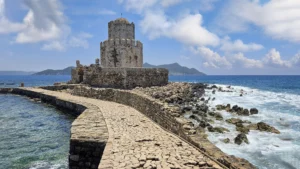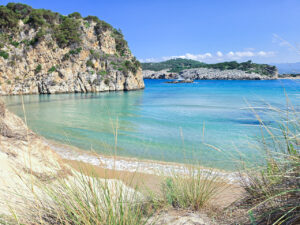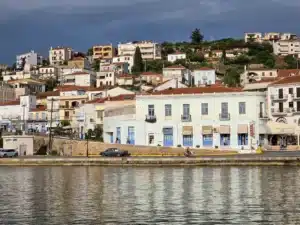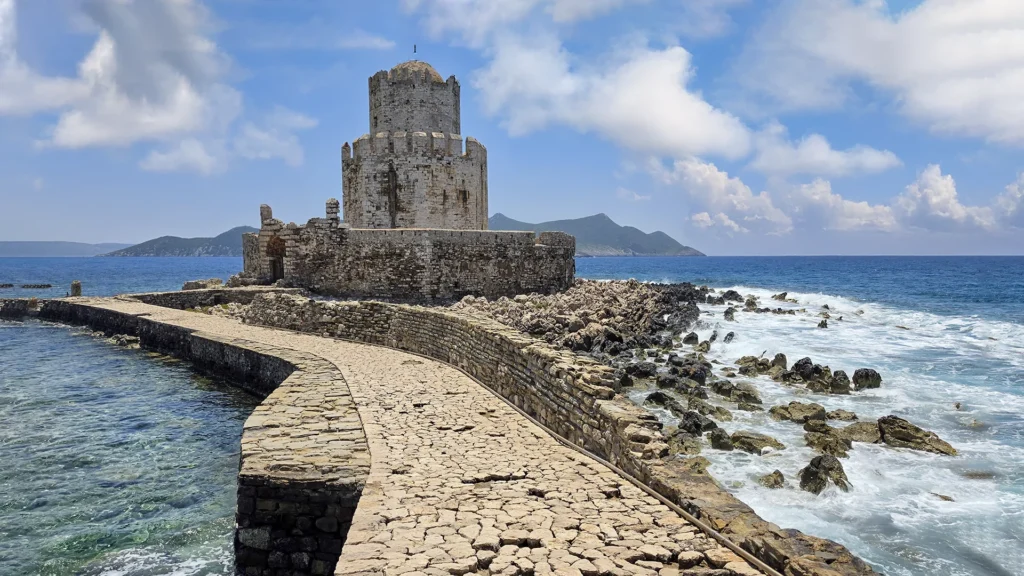
Methoni Castle is a large coastal archaeological site rather than a small castle building. The visitor route crosses a 14-arch stone bridge over the former moat and continues through the fortifications towards the Sea Gate and the offshore Bourtzi. Much of the site is open and exposed to sun and weather, so check opening hours, Bourtzi access and any restricted sections before you go. Methoni Castle was also officially used as a filming location for Christopher Nolan’s The Odyssey.
Methoni Castle at a glance
- Location: Methoni, Messenia
- Site type: extensive coastal fortress and archaeological site
- Main highlights: 14-arch bridge, main gate, interior ruins, Sea Gate and Bourtzi
- Walking: substantial outdoor walking on uneven surfaces
- Shade: limited
- Best time in summer: early after opening or later when conditions are cooler
- Tickets: required during normal paid-entry periods
- Weekly closure: currently Tuesday
- Parking: listed near the site, but exact availability is not guaranteed
- Bourtzi: normally approached by the sea walkway, subject to current access restrictions
- Film connection: officially confirmed location for The Odyssey
Where is Methoni Castle?
Methoni Castle occupies a coastal peninsula beside the modern town of Methoni, in Messenia, in the south-western Peloponnese. The land entrance faces the town, while the fortified peninsula projects into the sea, which surrounds it on three sides. Beyond the seaward end, the small islet with the Bourtzi tower stands just off the Sea Gate.
The archaeological entrance is separate from Methoni Beach, and the town’s restaurants, cafés, accommodation and services all remain outside the fortress walls. Methoni is a short drive south of Pylos, a separate town on Navarino Bay, so the castle is not in Pylos itself.
Methoni Castle opening hours and tickets
The following schedule reflects the official Hellenic Heritage information, last checked in July 2026. Hours change with the season, so treat these as a planning guide rather than a guarantee.
- 1 April – 31 August: 08:00–20:00
- 1–15 September: 08:00–19:30
- 16–30 September: 08:00–19:00
- 1–15 October: 08:00–18:30
- 16–31 October: 08:00–18:00
- 1 November – 31 March: 08:30–15:30
- Tuesday: closed
- Last admission: 20 minutes before closing
Published ticket prices are €5 for full admission and €3 for reduced admission. Reduced and free-entry eligibility, payment methods and any online options can vary, so do not assume a particular arrangement will apply on the day.
Opening hours, ticket prices, holiday closures and access to individual sections can change. Confirm the current information on the official Hellenic Heritage page for Methoni Castle before travelling.
Parking at Methoni Castle
Parking is listed among the official visitor amenities near Methoni Castle, and most visitors approach through the modern town before reaching the archaeological entrance. Availability varies by season and time of day, and a space directly beside the gate is not guaranteed in high summer.
Because conditions and signage can change, do not assume the parking is private, guarded, paved, free or paid without checking on arrival. Central Methoni is within practical walking distance of the entrance, so if the nearest area is full, look for a legal parking space in the town and walk from there, following current signs and local restrictions. Respect residents’ access and avoid blocking local roads. For the wider journey, our guide to planning your Peloponnese road trip covers driving and car hire across the region.
What to see inside Methoni Castle
The most rewarding way to understand Methoni Castle is to follow the visitor route from the bridge to the sea, treating it as an open archaeological landscape rather than an intact, furnished castle.
The 14-arch stone bridge
The visit begins by crossing the 14-arch stone bridge over the former defensive moat between the town and the castle entrance. It is the principal modern approach and one of the most photographed parts of the site. The current bridge is associated with the French Morea Expedition after 1828, so it is best not described simply as an original Venetian structure. Descriptions of the moat differ on whether it was dry or filled with seawater.
The main gate and ramparts
Beyond the bridge stands the monumental land gate, flanked by defensive walls and ramparts — the threshold between modern Methoni and the former fortified settlement, and an immediate sense of the scale of the defences. Not every wall or tower is open for climbing, so follow any barriers on site.
The route through the former fortified town
Inside, an old paved route leads through what was once a fortified town. Along the way you can pick out surviving building foundations, Ottoman baths, architectural fragments, the Church of the Transfiguration of the Saviour, a gunpowder store and other remains. Much of what stood here has gone, so the interior reads as an open archaeological landscape rather than a set of complete buildings.
The Morosini column
Within the interior stands a granite column traditionally associated with Francesco Morosini and Venetian rule. It is a column rather than a complete statue, and whether any surviving Lion of Saint Mark is currently visible on top is best confirmed on site rather than assumed.
The Sea Gate
Following the route towards the water, you reach the seaward end of the fortress and the restored Sea Gate, where the enclosed interior gives way to the exposed edge of the peninsula.
The sea walkway and Bourtzi
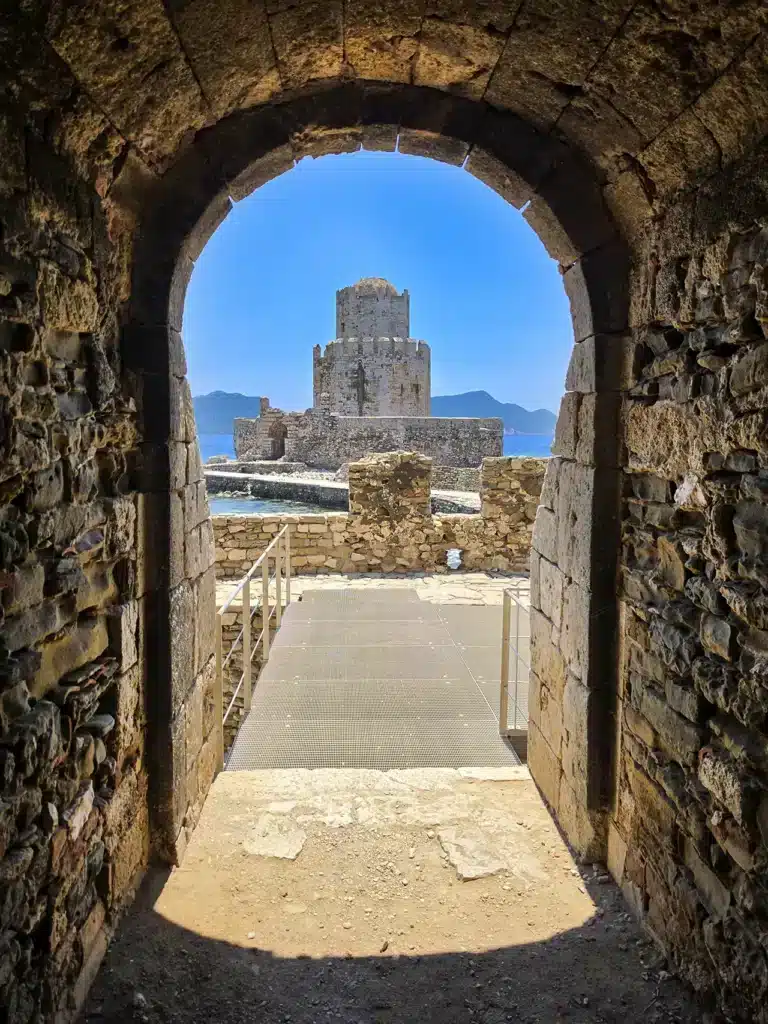
From the Sea Gate, a narrow paved sea walkway continues towards the small islet and the Bourtzi, an octagonal two-storey fort begun under the Venetians shortly before 1500 and completed under Ottoman rule. Its silhouette against the sea is one of Methoni’s defining views. Note that Methoni’s Bourtzi is a different structure from the better-known Bourtzi in Nafplio.
Access to the walkway, islet and Bourtzi interior depends on current safety, conservation and site restrictions, so do not assume the walkway is open or that every level of the tower is reachable on the day.
What is the visit really like?
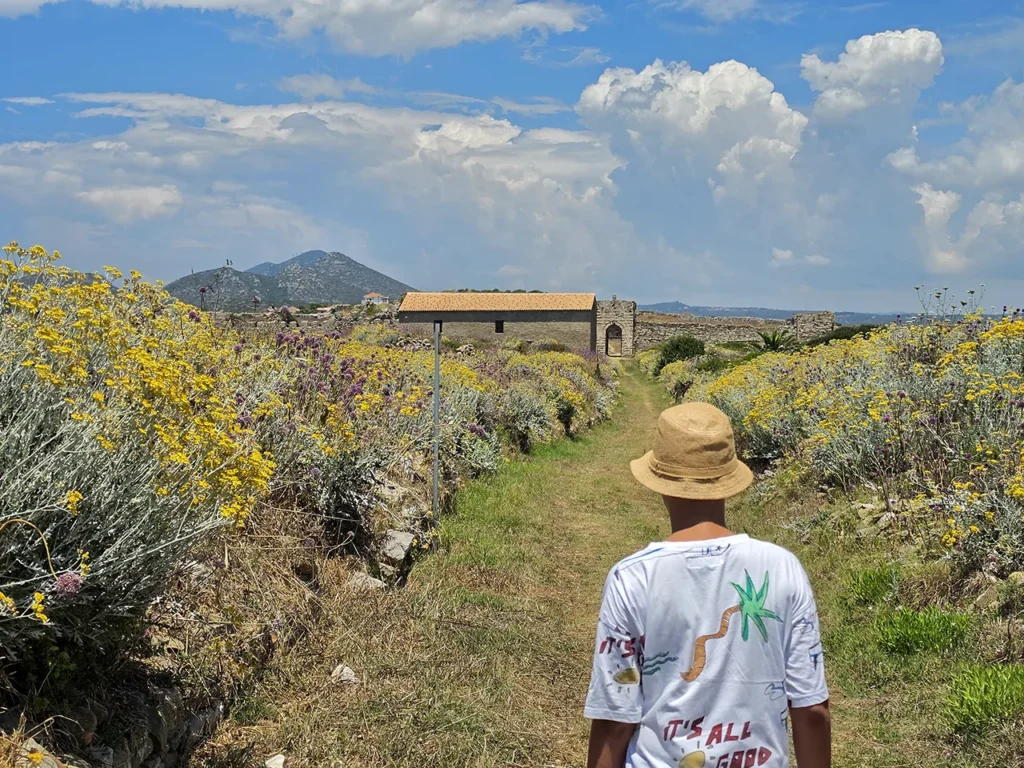
Much of the visit is outdoors, on uneven paths, cobbles, gravel and exposed ground with limited shade, and the route out towards Bourtzi adds further walking. On the seaward sections, wind and sea spray can be noticeable, and some areas may be closed for conservation or safety. None of this makes the visit difficult for reasonably mobile travellers, but it is not a flat, step-free stroll: comfortable footwear, water and a realistic pace matter here.
When is the best time to visit Methoni Castle?
Summer
In high summer, visit soon after opening or later in the day, while respecting the final admission time, as midday heat makes the exposed site uncomfortable. Sunset may fall after the site has closed, so do not count on staying inside for it.
Spring and autumn
Spring and autumn usually offer more comfortable walking conditions, with softer light for photography. Wind and rain remain possible, so check the forecast and bring a light layer.
Winter
In winter the hours are shorter and the weather more unsettled, so plan around the reduced timetable and the possibility of wind or rain on the exposed peninsula. It can still be a fine visit, but it rewards flexibility.
No season guarantees quiet conditions, so treat crowd levels as variable.
How long do you need at Methoni Castle?
As an editorial estimate rather than an official visiting time, roughly one to two hours suits the principal route for most visitors. Anyone keen on history or photography may want longer, and Bourtzi access, heat, mobility and restricted sections all affect the duration. It is not a site you can fairly cover in half an hour.
What to bring
Pack for an exposed outdoor site
- drinking water;
- a hat;
- sunscreen;
- stable, closed footwear;
- a charged phone;
- a camera;
- a light wind layer outside midsummer;
- any necessary medication.
Leave the flip-flops for the beach — the uneven archaeological surfaces call for footwear that grips.
Accessibility at Methoni Castle
Accessibility is listed among the official visitor amenities, but that does not mean every section is step-free. The bridge, the exposed archaeological interior, the uneven surfaces and the route out to Bourtzi all present different practical conditions, and some cannot be assumed to suit every visitor.
Travellers with reduced mobility should contact the archaeological site before travelling to confirm what is realistic, using the contact details on the official page. In particular, do not assume wheelchair access to Bourtzi without current confirmation.
Visiting Methoni Castle with children
The bridge, the open space and the offshore Bourtzi can all hold children’s interest, and there is room to walk and explore. That said, the site is large and exposed, with walls, drops, uneven surfaces and a narrow sea walkway, so children need close supervision throughout, kept well away from the edges and the walkway.
Pushchair suitability varies by route and cannot be guaranteed across the whole site, so plan for some carrying with very small children.
A short history of Methoni Castle
Methoni was fortified in the Byzantine period before the Venetians took control in the early 13th century. As a Venetian possession the town, which they called Modon, became a strategic port on the routes between Venice and the eastern Mediterranean, and the site is sometimes described as Methoni Fortress.
The Ottomans captured Methoni in 1500. A second Venetian period followed, before Ottoman rule returned. During the Greek War of Independence, Ibrahim Pasha used Methoni as a base, and in 1828 his Egyptian forces surrendered Methoni to the French expeditionary force. The settlement later moved outside the walls to the modern town. Because the defences were built and rebuilt across these periods, not every visible structure belongs to the same era.
Methoni Castle in Christopher Nolan's The Odyssey
Methoni Castle is a confirmed filming location for Christopher Nolan’s The Odyssey. EKKOMED – Creative Greece lists Pylos, Methoni Castle, Acrocorinth, Voidokilia Beach and Armyrolakkos Beach among the Greek filming locations, and the Hellenic Film Commission worked with the production, with permission granted under conservation conditions.
Beyond that, we stay with what the cited official sources support. The official EKKOMED and Hellenic Film Commission pages do not identify the scene, character or narrative setting represented by Methoni Castle. For the full picture, see our overview of all confirmed Peloponnese filming locations for The Odyssey.
What to combine with Methoni Castle
Methoni town and beach
The restaurants, cafés, accommodation and town beach all sit outside the archaeological site, so it is easy to combine the castle with a meal or a swim in the town.
Pylos
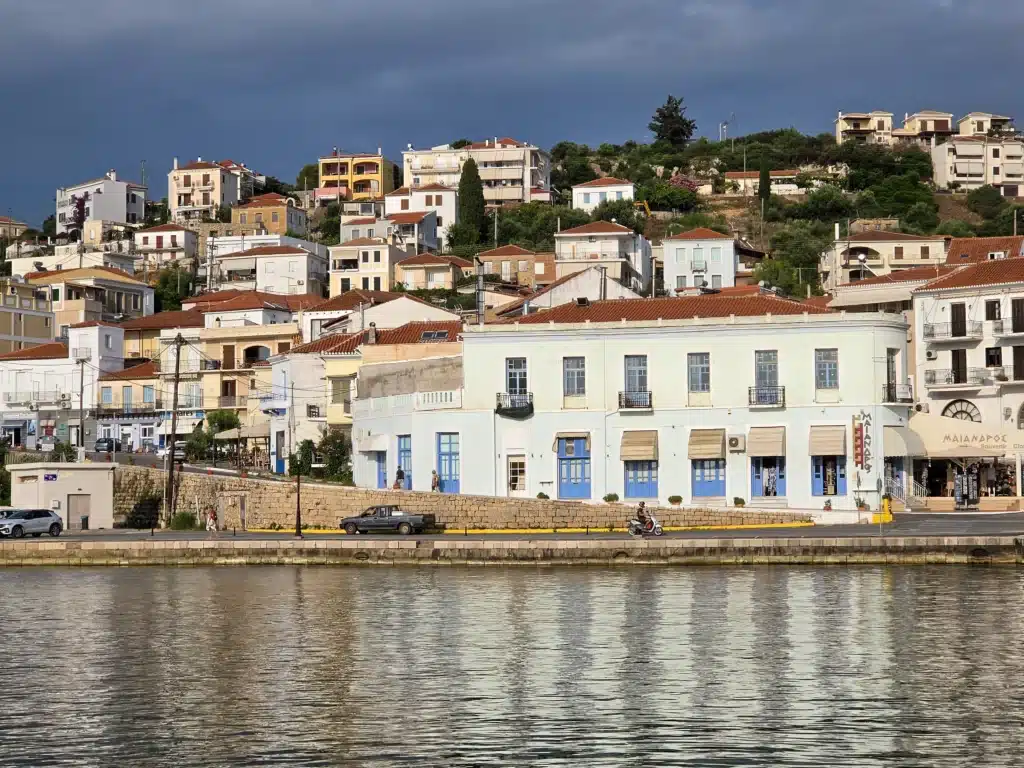
A short drive north, Pylos is the stronger nearby town base for a wider Navarino Bay trip, with a harbour, squares and the Niokastro fortress. Our complete Pylos, Gialova and Voidokilia guide compares the bases in detail.
Voidokilia Beach

The horseshoe bay of Voidokilia is a separate beach excursion with its own access and parking, rather than a quick add-on. Our practical Voidokilia Beach guide explains how to reach it and when to go.
Finikounda
South-east of Methoni, Finikounda is a separate coastal stop with sandy beaches, worth its own short drive if you have time.
Koroni
On the other side of the Messenian peninsula, Koroni is a further castle town that needs additional driving, so treat it as a separate day.
Do not try to fit Pylos, Voidokilia, Finikounda and Koroni into one half-day — pick the castle plus one nearby stop. For broader ideas, our overview of the best Peloponnese resorts and destinations helps shape a wider route.
Where should you stay for Methoni Castle?
Choose Methoni if the castle, the beach and a slower coastal stay are central to your trip. Choose Pylos if Methoni Castle is one stop in a wider Navarino Bay itinerary and you would rather have a larger town as your base. Either way, check the exact property location and its parking arrangement before booking, as not every Methoni property is within easy walking distance of the entrance.
For a coastal stay with the castle and town beach close at hand, start with Methoni.
If you would prefer a larger base for touring the wider bay, with the castle as one day trip among several, look at Pylos.
Some links are affiliate links: if you book through them we may earn a small commission at no extra cost to you.
To weigh up the wider region, our guide to the best places to stay across the Peloponnese sets Methoni and Pylos in context, and if you are arriving through the regional airport, our Kalamata travel guide covers the approach from the east.
Frequently asked questions
Is Methoni Castle worth visiting?
Yes, for anyone interested in history, coastal fortifications or photography. It is a large, atmospheric archaeological site with a striking bridge, an open interior and the offshore Bourtzi. Come prepared for outdoor walking on uneven ground with limited shade.
What are the current Methoni Castle opening hours?
Hours change by season, running roughly 08:00–20:00 in high summer and 08:30–15:30 from November to March, with last admission 20 minutes before closing and closure on Tuesdays. Confirm the current times on the official Hellenic Heritage page before travelling.
How much are Methoni Castle tickets?
The published prices are €5 for full admission and €3 for reduced admission. Eligibility for reduced or free entry and payment methods can vary, and prices change over time, so check the official Hellenic Heritage page before your visit.
Is Methoni Castle closed on Tuesdays?
At the time of verification the site is closed on Tuesdays. Weekly closures and public-holiday arrangements can change, so confirm the current schedule on the official Hellenic Heritage page before travelling.
Is there parking at Methoni Castle?
Parking is listed among the visitor amenities near the site, but availability varies by season and time of day and a space beside the gate is not guaranteed. If the nearest area is full, look for a legal parking space in central Methoni and walk from there, following current signs and local restrictions.
How long do you need at Methoni Castle?
Around one to two hours suits the main route for most visitors, as an editorial estimate rather than an official time. History enthusiasts and photographers may want longer, and heat, mobility and Bourtzi access all affect the duration.
Can you walk to Bourtzi?
Bourtzi is normally reached by a narrow paved sea walkway from the Sea Gate, but access depends on current safety, conservation and site restrictions. Do not assume it is always open; check on arrival and keep clear of the exposed edges.
Is Bourtzi included in the Methoni Castle visit?
Bourtzi is part of the wider monument, but do not assume entry to the tower is guaranteed with every ticket or on every day. The walkway and interior can be restricted for safety or conservation, so treat access as subject to current conditions.
Is Methoni Castle suitable for children?
It can be, as the bridge, open space and Bourtzi hold interest, but the site is large and exposed, with walls, drops, uneven ground and a narrow sea walkway. Children need continuous supervision and should be kept away from the edges.
Is Methoni Castle wheelchair accessible?
Accessibility is listed among the amenities, but not every section is step-free, and the bridge, uneven interior and Bourtzi route differ in difficulty. Visitors with reduced mobility should contact the site in advance, as wheelchair access to Bourtzi should not be assumed.
What should you wear at Methoni Castle?
Wear stable, closed footwear for the uneven surfaces, with a hat and sun protection in summer and a light wind layer at other times. Avoid flip-flops, and carry water, as shade is limited across much of the fortress.
Was Methoni Castle used in The Odyssey?
Yes. Methoni Castle is a confirmed filming location for Christopher Nolan’s The Odyssey, listed by EKKOMED among the Greek locations with the Hellenic Film Commission involved. The cited official sources do not identify the exact scene or narrative setting represented by the castle.
Is Methoni Castle Venetian or Ottoman?
Both, with earlier Byzantine origins. The site was fortified before Venetian control from the early 13th century, captured by the Ottomans in 1500, held again by Venice, and later Ottoman once more. Because it was built and rebuilt over centuries, different structures belong to different periods.
Can you combine Methoni Castle with Pylos or Voidokilia?
Yes, though not all at once. Pylos is a short drive north and makes a natural pairing, while Voidokilia is a separate beach excursion with its own access and parking. Pick the castle plus one nearby stop rather than several in a half-day.