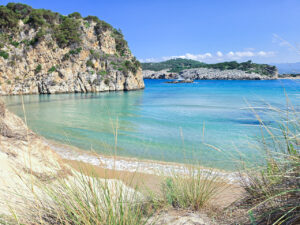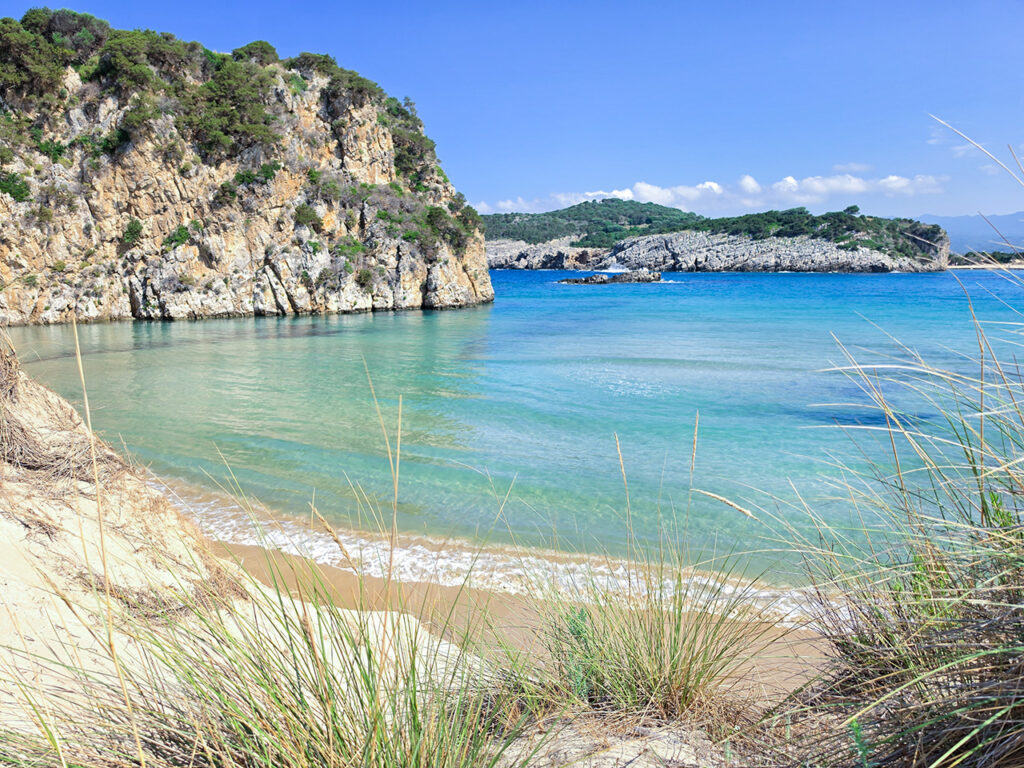
Voidokilia is an unorganised, protected sandy bay in Messenia, and planning matters more than it looks. There is a parking area near the beach, but spaces are not guaranteed, and the final approach includes a dirt-road section. July and August can be crowded, and there are no beach facilities, so bring water, food and shade. The slopes above hold Nestor’s Cave and Paleokastro, neither of which is a normally open visitor attraction — this guide explains how to visit responsibly.
Voidokilia Beach at a glance

- Location: Messenia, near Petrochori and Gialova
- Beach type: natural sandy bay
- Facilities: no organised beach facilities
- Parking: available nearby, not guaranteed
- Final access: dirt-road section
- Best quieter periods: May–June and September–October
- Best summer timing: early morning or late afternoon
- Shade: bring your own
- Food and water: bring everything required
- Nestor’s Cave: not officially open to visitors
- Paleokastro: closed to visitors
- Recommended base: Gialova for proximity, Pylos for a fuller town stay
Where is Voidokilia Beach?
Voidokilia (occasionally written Voidokoilia in English) sits on the western coast of Messenia, north-west of Gialova and close to the village of Petrochori. It lies just beyond Divari Beach and the Gialova Lagoon, on the far side of Navarino Bay from Pylos.
Above the beach rise the slopes that hold Nestor’s Cave and the ruined fortress of Paleokastro. It is worth being clear that Voidokilia and the Gialova Lagoon are adjacent but ecologically distinct: the lagoon is a protected wetland for birdlife and nature, not a conventional bathing beach, while Voidokilia is the sandy bay itself.
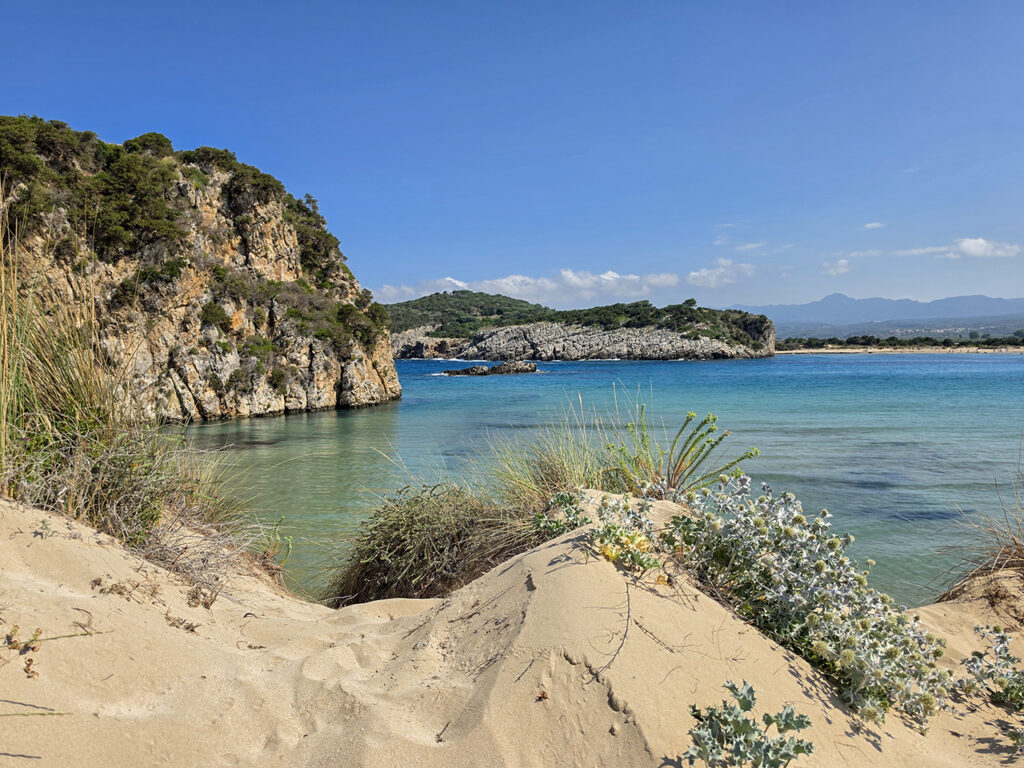
The bay is best known for its near-perfect horseshoe curve, backed by low dunes rather than any development, which is exactly why it feels so different from an organised resort beach. That same natural character is the reason planning matters: the qualities that make it special — no facilities, a protected setting and a semi-wild approach — are also the things that catch unprepared visitors out.
How to get to Voidokilia Beach
Most visitors drive. As a rough guide from the currently published Discover Greece information, Voidokilia is about 9 km from Gialova, roughly 17 km from Pylos, and around 55 km from Kalamata Airport. Treat these as approximate; the exact time depends on your starting point, traffic and road conditions.
The normal approach is to drive towards Petrochori and follow the current local signs towards Voidokilia. The final stretch includes a dirt-road section, and surfaces and access can change, so drive slowly and do not assume the road suits every low-clearance vehicle in all conditions.
There is also an approach from the Gialova Lagoon or Divari side, where parking may be possible and a longer walk can connect towards Voidokilia. Use only current, authorised paths — routes through the protected area can change — and do not treat this as the easiest option for everyone.
Public transport is limited. Buses may reach Pylos or, seasonally, Romanos, but you must check the current KTEL Messinias timetable and solve the final connection to the beach separately. If you are arriving through the airport, our Kalamata travel guide covers the wider approach to this corner of Messenia.
Parking at Voidokilia Beach
There is a parking area near the beach, reached by that final dirt-road approach. Spaces are not reservable or guaranteed, and conditions can be dusty or rough. July and August put the most pressure on parking, so arriving early in the morning or later in the afternoon may reduce the congestion.
Obey any signs and temporary restrictions, and treat the setting as protected: never park on the dunes, never block the access track, and do not assume roadside parking is permitted. Do not assume that the parking area is supervised or secure, and do not leave valuables visible inside the car.
From wherever you leave the car, expect a short walk across sand to reach the water, and factor that into how much you carry — water, shade and a cool-box add up quickly in the heat. If you are travelling with anyone who finds soft sand or uneven ground difficult, plan the day around that rather than assuming a level, direct path from the parking to the shore.
When is the best time to visit Voidokilia?
May and June

Often the sweet spot: pleasant beach weather with generally lower pressure than peak summer. Sea and weather still vary, so check conditions before you plan a full day around swimming.
July and August
The hottest and busiest months. Come early in the morning or later in the afternoon, bring substantial water and your own shade, and expect parking to be harder. Crowds build through the day rather than at one fixed hour.
September and October
Frequently warm with fewer visitors, which many travellers prefer. Swimming weather is likely but not guaranteed, so keep an eye on the forecast.
Winter and early spring
The bay and lagoon remain rewarding for the landscape and birdlife, but a visit becomes weather-dependent and is not primarily a swimming day. Expect a walk and a view rather than a beach afternoon.
Whichever month you choose, do not expect an empty beach — Voidokilia draws visitors across the season.
What facilities are available?
Voidokilia is not an organised beach. Do not assume that sunbeds, umbrellas, beach bars, food, drinking water, toilets, showers, changing rooms, lifeguards or medical assistance will be available. Come fully self-sufficient.
What to bring
- drinking water;
- food and snacks;
- sun protection;
- a hat;
- an umbrella or portable shade;
- a towel;
- suitable footwear;
- a rubbish bag;
- basic first-aid supplies;
- a charged phone;
- binoculars for the lagoon, where useful.
Is Voidokilia suitable for children?
The sheltered horseshoe and its shallow inner curve can suit families, but conditions still change with wind, waves and weather, and there may be no lifeguard. Children need continuous supervision.
Shade is limited or absent, and the heat and the walk across soft sand can be tiring for small children, so arrive prepared and be ready to leave if conditions become uncomfortable. Do not treat the water as always calm or the beach as safe for everyone in all conditions.
Protecting the beach, dunes and Gialova Lagoon
Voidokilia and the neighbouring lagoon are part of a sensitive protected landscape, and how you behave matters. Stay on existing authorised paths, keep off the protected dunes and vegetation, and give birds and other wildlife space.
Take all your rubbish away, avoid loud music, never light fires, and do not remove sand, shells, rocks or plants. Follow any current environmental notices on site. If you are considering a drone, confirm the current aviation and protected-area restrictions first — do not assume flying is permitted here.
Can you visit Nestor's Cave?
Nestor’s Cave is not officially open to visitors.
It sits on the slopes above Voidokilia and carries a rich mythology — tradition links it to Nestor and Hermes — with Neolithic and later archaeological evidence found in and around it. Its entrance can often be seen from the surrounding landscape, and a rough, exposed path leads towards the area, but none of that permits entry. Follow the current signs and restrictions, treat it as an optional approach to the setting rather than an attraction, and do not attempt to go inside. The cave is one of The Odyssey filming locations in the Peloponnese, which adds to the interest without changing how you visit.
Can you visit Paleokastro?
Paleokastro is closed to visitors.
Also written Palaiokastro or Paliokastro, and known as Old Navarino Fortress or Nestor’s Castle, it is the ruined medieval fortress above the Voidokilia area — a different site from Niokastro, the New Navarino Fortress in Pylos. Paths in the surrounding landscape may give elevated views where access is authorised, but the terrain becomes steep, exposed and potentially dangerous. It is not a managed visitor attraction, so respect any closure notices and do not enter closed sections of the ruins. No viewpoint is worth ignoring a safety restriction.
Palace of Nestor, Nestor’s Cave and Paleokastro are three different places
The Palace of Nestor is a managed Mycenaean archaeological site inland near Chora. Nestor’s Cave is a closed cave on the slopes above Voidokilia. Paleokastro is a closed ruined fortress above the coastal area. They share the Nestor name but are separate locations.
What else can you combine with Voidokilia?
Gialova Lagoon
A protected wetland for birdwatching and nature, best explored on the authorised paths — check current access before setting out.
Divari Beach
A long beach beside Navarino Bay, and a genuinely separate stretch from Voidokilia rather than part of the same bay.
Gialova
The closest practical waterfront base for most visitors, with restaurants, cafés and a beach-holiday atmosphere. Petrochori is geographically closer to Voidokilia, but Gialova provides a broader choice of accommodation and visitor services.
Pylos and Niokastro
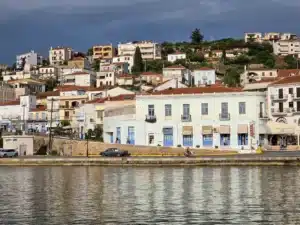
Across Navarino Bay, Pylos offers town atmosphere, a harbour and Niokastro, the New Navarino Fortress. Unlike Paleokastro, Niokastro operates as a managed archaeological and museum site when open. Check current opening hours and admission before travelling. For wider destination context, see our overview of the best Peloponnese resorts and destinations.
Palace of Nestor
The Palace of Nestor is a separate Mycenaean archaeological site inland near Chora. Check the site’s current opening hours and admission before travelling. The Archaeological Museum of Chora is a separate attraction whose operating status should also be confirmed if you plan to combine the two.
Do not try to fit all of these into a rushed half-day — pick one or two alongside the beach.
Where should you stay for Voidokilia Beach?
There is no accommodation “inside” Voidokilia — it is a protected beach, not a resort centre — so base yourself nearby and drive out. Choose Gialova for the most practical proximity and a beach-focused stay, or Pylos for a stronger town atmosphere, more sightseeing and a balanced regional base. Always check the exact map position of anything marketed as being “near Voidokilia”.
Our full where to stay in Pylos or Gialova guide compares the two bases in detail, and our overview of the best places to stay across the Peloponnese sets the area in a wider context.
For a beach-first stay with the shortest drive to Voidokilia, start with Gialova:
If you would rather have the town, harbour and fortress on your doorstep and treat the beach as a day trip, look at Pylos:
Some links are affiliate links: if you book through them we may earn a small commission at no extra cost to you.
How long should you spend at Voidokilia?
Several hours are enough for the beach itself — a swim, a walk around the horseshoe and time on the sand. A full day lets you slow down and add a separate stop in Gialova or at Divari.
Nestor’s Cave is not officially open to visitors, and Paleokastro is closed under the currently published guidance, so do not build your day around entering either site. Heat, parking and the walk across soft sand shape what is realistic more than any fixed schedule. If you are mapping a wider route, our guide to planning your Peloponnese road trip helps you fit Voidokilia into the bigger picture.
Frequently asked questions
Is there parking at Voidokilia Beach?
Yes, there is a parking area near the beach, reached by a dirt-road approach, but spaces are not reservable or guaranteed and it can be busy in high season. Do not assume that the parking area is supervised or secure. Obey current signs, keep off the dunes and do not leave valuables visible in the car.
Is the road to Voidokilia Beach paved?
The main roads towards Petrochori are surfaced, but the final approach to the beach includes a dirt-road section that can be rough or dusty. Drive slowly, and do not assume it suits every low-clearance vehicle in all conditions. Road surfaces can change, so follow current local signs.
What is the best time to visit Voidokilia?
May–June and September–October usually offer warm weather with fewer visitors than peak summer. In July and August, go early in the morning or later in the afternoon and bring plenty of water and shade. No month guarantees an empty beach or specific swimming conditions.
Does Voidokilia have sunbeds or a beach bar?
No. Voidokilia is an unorganised, protected beach, so do not assume sunbeds, umbrellas or a beach bar will be available. Bring your own shade, water and food, and plan to be fully self-sufficient for the day.
Are there toilets at Voidokilia Beach?
Do not assume that toilets, showers or changing facilities will be available at the beach. As an unorganised natural site, it has no guaranteed visitor services, so plan accordingly and use facilities in Gialova or Pylos before you set out.
Is Voidokilia suitable for children?
The sheltered bay and shallow inner curve can suit families, but there may be no lifeguard, shade is limited, and conditions change with wind and weather. Children need continuous supervision, and families should arrive prepared and leave if conditions become uncomfortable.
Can you visit Nestor's Cave?
Nestor’s Cave is not officially open to visitors. It sits on the slopes above Voidokilia, and its entrance may be visible from the surrounding landscape, but you must not attempt to enter. Follow current signs and restrictions and treat it as scenery rather than an attraction.
Can you enter Paleokastro?
No. Paleokastro, the Old Navarino Fortress above Voidokilia, is closed to visitors. Surrounding paths may give elevated views where access is authorised, but the terrain is steep and exposed, and you must not enter closed sections of the ruins or ignore closure notices.
Is the Palace of Nestor near Nestor's Cave?
No. The Palace of Nestor is a separate Mycenaean archaeological site inland near Chora, north-east of Pylos. Nestor’s Cave is on the coast above Voidokilia. They share a name and are often confused, but they are different places suited to different visits.
Should you stay in Pylos or Gialova for Voidokilia?
Gialova is the closest practical base, with the shortest drive to Voidokilia and a beach-focused feel. Pylos is a little further but offers more town life, restaurants and the Niokastro fortress. Both work well; it comes down to beaches versus town atmosphere.
Can you reach Voidokilia without a car?
It is difficult. Buses may reach Pylos or, seasonally, Romanos, but there is no guaranteed direct service to the beach, so you would need to arrange the final connection by taxi or another means. Check the current KTEL Messinias timetable and plan the last leg carefully.
How long should you spend at Voidokilia?
Several hours cover the beach comfortably, while a full day lets you add Gialova or Divari at a relaxed pace. Do not plan around entering Nestor’s Cave or Paleokastro: the cave is not officially open to visitors, and the fortress is closed under the currently published guidance; heat and parking shape what is realistic.