Knossos in a nutshell: Crete’s most famous Minoan archaeological site, just outside Heraklion, and since 2025 a UNESCO World Heritage Site as part of the serial property “Minoan Palatial Centres”. Allow roughly 2–3 hours for most visits rather than a full day — and pair it with the Heraklion Archaeological Museum, which makes the whole experience significantly more useful.
Knossos is Crete’s best-known archaeological site and, for most travellers, the centrepiece of the Minoan world. It sits on the edge of Heraklion, which makes it one of the island’s easiest cultural trips — including without a car.
It is also one of the most misunderstood. Much of what you see — the red columns, the upper floors, the displayed frescoes — comes from 20th-century reconstructions by Arthur Evans, not from the Minoan builders. Knowing that in advance completely changes how you read the site. For planning the rest of the island, start with our Crete travel guide.
Quick decisions
Best for: history and archaeology, first-time Crete visitors, families with older children interested in mythology.
Allow: around 2–3 hours for most visitors.
Best time: early morning or later in the day, especially in hot summer weather.
Ticket: €20 full / €10 reduced when checked in August 2026.
From Heraklion: approximately 15 minutes by car or around 20 minutes by city bus, according to the official visitor information.
Combine with: the Heraklion Archaeological Museum. Shade: limited in many parts of the site — bring water, sun protection and suitable footwear.
Contents
Knossos at a glance · Is Knossos worth visiting? · Tickets and opening hours · Best time to visit · What to see · History in 5 minutes · Myth vs archaeology · Arthur Evans and the reconstructions · How long you need · Knossos with kids · How to get there · Knossos + Heraklion Museum · Common mistakes · FAQ · Verdict
Knossos at a glance
| Location | On the southern edge of Heraklion, northern Crete |
| UNESCO status | World Heritage since 2025, as one of the six “Minoan Palatial Centres” |
| Ticket | €20 full / €10 reduced (checked August 2026 — verify before visiting) |
| Opening hours | Seasonal — 08:00–20:00 in high summer; full schedule below |
| Time needed | Around 2–3 hours for most visitors |
| Best time | Early morning or later in the day in summer |
| From Heraklion | ~15 minutes by car / ~20 minutes by city bus (official figures) |
| Best combined with | Heraklion Archaeological Museum |
| Accessibility / terrain | Uneven archaeological ground, steps, limited shade; some accessible routes exist — check current conditions |
Is Knossos worth visiting?
For most first-time visitors to Crete: yes. Knossos is where the Minoan civilisation becomes physical — scale, architecture, spatial organisation — and no other site on the island communicates it as directly, partly because of the reconstructions.
Two honest caveats. First, part of what you see is 20th-century reconstruction, not untouched Minoan fabric — the site rewards visitors who understand that distinction. Second, if archaeology genuinely doesn’t interest you, you should not feel obliged to spend half a holiday day here simply because it is famous.
Tickets and opening hours
Knossos uses the official Hellenic Heritage e-Ticket system. When checked in August 2026, the full ticket was €20 and the reduced ticket €10. Official online tickets are available through the Hellenic Heritage platform — admission rules and prices can change, so verify the official page before your visit.
Opening hours (checked August 2026 — verify before your visit)
1 April – 31 August: daily 08:00–20:00
1–15 September: 08:00–19:30 · 16–30 September: 08:00–19:00
1–15 October: 08:00–18:30 · 16–31 October: 08:00–18:00
1 November – 31 March: 08:00–17:00
Last admission: 20 minutes before closing.
Closed: 1 January, 25 March, 1 May, Easter Sunday, 25 and 26 December.
In peak season, checking availability for your chosen day in advance saves surprises at the entrance. Don’t rely on prices or hours found in old blog posts — including combined-ticket arrangements with the museum, which should be checked for your exact date.
Best time to visit
In summer, early morning is usually the safest choice: the site is a large open archaeological area with limited shade in many parts, and midday heat can make the visit genuinely hard work. Later in the day can also work well, depending on the seasonal closing time.
Earlier arrival can also help reduce visitor pressure, although no time slot guarantees a quiet site. In shoulder season, conditions are generally easier across the whole day.
During extreme heat, Greek authorities may temporarily close archaeological sites during the hottest part of the day, so check official announcements on exceptionally hot summer days.
What to look for at Knossos
The site is extensive and can feel confusing without a few fixed points. These are the principal features worth seeking out — the rest of the visit arranges itself around them.
West Court and the approach
The paved open area you cross soon after the entrance, originally a formal approach to the palace’s west façade. It is a good first pause: from here the sheer footprint of the complex — roughly 22,000 square metres — starts to make sense.
Central Court
The open space at the heart of the complex, around which the wings were organised. It is the best orientation point on the site: ceremonial areas towards the west, residential quarters and workshops towards the east.
Throne Room
The site’s most celebrated room: an alabaster seat flanked by stone benches and griffin frescoes. The name is Evans’ — the room’s real function is still debated, with interpretations ranging from ceremonial to religious. Viewing arrangements can vary, as access is managed for conservation.
Grand Staircase
On the east side of the Central Court, the monumental staircase served a wing built on several levels down the slope of the hill. It is one of the places that best conveys the building’s vertical complexity. Access can be restricted for conservation.
Royal Apartments and the Queen's Megaron
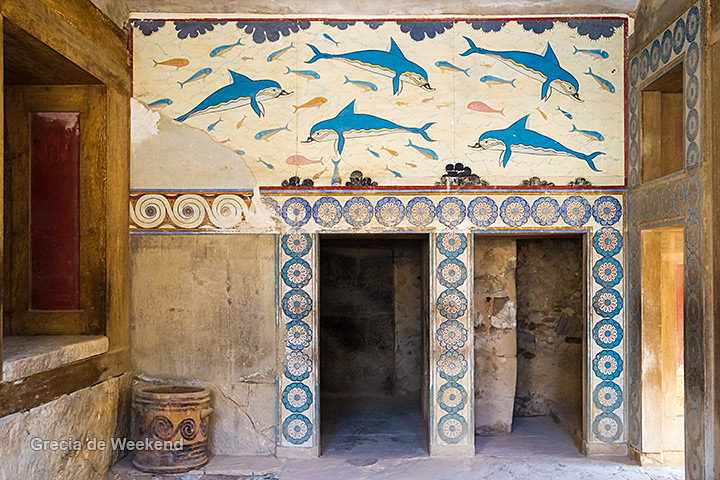
The area Evans associated with the “royal apartments”, famous for its dolphin fresco and the Hall of the Double Axes nearby. The attribution is an interpretation rather than a certainty — and the dolphin fresco you see on site is a reproduction, with important originals preserved in the Heraklion Archaeological Museum.
Storage magazines and pithoi
Rows of storerooms holding giant ceramic jars — pithoi — once filled with oil, wine and grain. They show the economic dimension of the palace: Knossos was not just a residence and sanctuary but a hub for collecting and redistributing resources.
North Entrance and the bull fresco
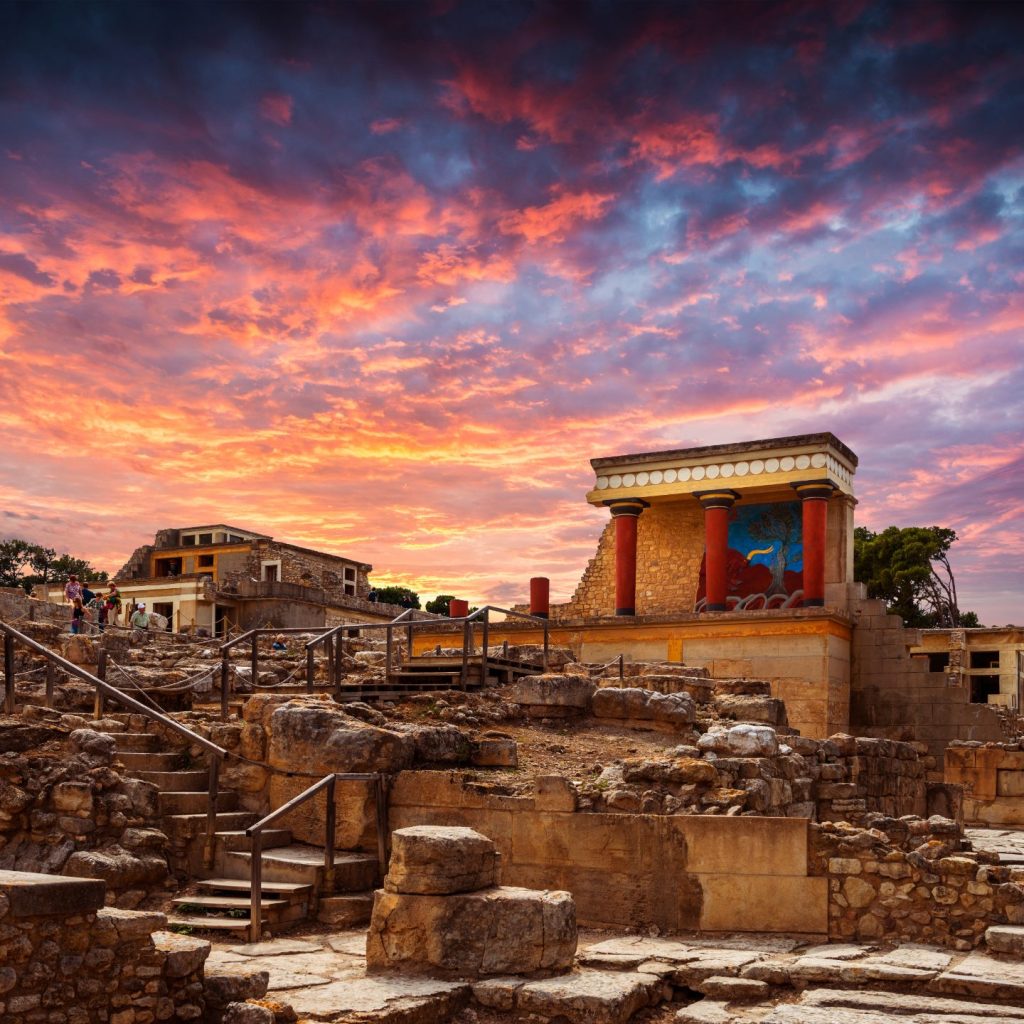
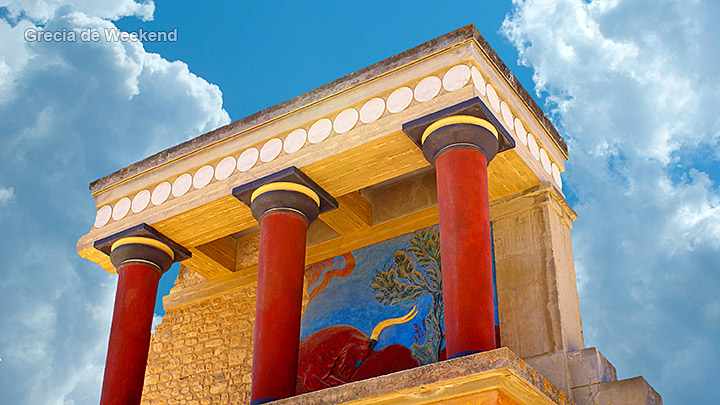
The reconstructed portico with the charging-bull image — the classic Knossos photograph. What you see here includes modern work: the red columns and portico are largely Evans-era reconstructions raised over the original remains.
Theatre Area and the Royal Road
In the north-west corner, a stepped area conventionally called “theatral” — its exact function is uncertain; it may have served ceremonies or gatherings. From here runs the paved Royal Road, once flanked by buildings and workshops. The Minoans were also skilled water engineers: look for the drainage channels threaded through the complex.
Important: not everything you see at Knossos is original
Much of the surviving low masonry and archaeological foundations is ancient fabric, while many of the columns, upper levels and coloured architectural elements visitors notice most are Evans-era reconstructions. Several frescoes displayed on site are reproductions or restorations — many originals are kept at the Heraklion Archaeological Museum.
That doesn’t make the site “fake”: it means you are visiting an authentic Minoan site and a 20th-century interpretation of it at the same time. Knowing this, you read what’s in front of you correctly.

Knossos history in 5 minutes
The Knossos area was inhabited from the Neolithic period through to Roman times — the palace is one chapter in a much longer story. The Minoan heyday spans roughly 2000–1350 BC.
The first palace was erected around 2000–1900 BC and destroyed around 1700 BC, traditionally associated with an earthquake. A larger palace was then built on the site — the complex whose remains, covering approximately 22,000 square metres, you walk through today.
At its peak, Knossos was one of the principal political, economic and religious centres of Minoan Crete — an administrative, storage and ceremonial complex, not merely a residence. That multi-purpose character is exactly what the courts, magazines and staircases still communicate.
In 2025, Knossos was inscribed on the UNESCO World Heritage List — not as a standalone property, but as one of the six component sites of the serial property “Minoan Palatial Centres”, alongside Phaistos, Malia, Zakros, Zominthos and Kydonia. Each of the six has its own scale, landscape and state of preservation.
Myth vs archaeology: Minos, the Labyrinth and the Minotaur
Knossos owes much of its modern fame to Greek mythology. This is the palace associated with King Minos, who — the story goes — had Daedalus build a labyrinth to hold the Minotaur, half man and half bull; Theseus killed the creature with the help of Ariadne’s thread, and Daedalus and Icarus made their winged escape from Crete.

Archaeology tells a different story. The palace complex is real, and its unusually intricate organisation — hundreds of rooms, corridors and levels — probably helped reinforce the later Labyrinth association, though that link is an inference, not a proven fact. King Minos is not a documented historical monarch, and the Minotaur is mythology.
The visit gets more interesting precisely when you keep the two planes separate: the real ruins, and the story that made them famous. For families, telling children the myth beforehand turns the stones into a stage — as long as everyone knows it is a story.
Arthur Evans and the reconstructions
The first excavations at Knossos were carried out in 1878 by Minos Kalokairinos, a Cretan merchant and antiquarian, on Kephala Hill. The British archaeologist Arthur Evans began systematic excavations in 1900, and his work continued over the period 1900–1931, uncovering the palace and a substantial part of the surrounding town.
Evans did far more than excavate. He carried out extensive architectural and decorative reconstruction, using reinforced concrete and his own interpretations — and it is this work, as much as the Minoan remains, that created the visual identity visitors associate with Knossos today. It is also why Knossos looks so different from Phaistos or Malia, where modern intervention was far more limited.
The balanced view: the reconstructions remain archaeologically controversial, but they help visitors grasp the volumes, storeys and colours of a Minoan building. What you see is partly archaeological fabric and partly 20th-century reconstruction — neither a fraud nor a faithful restoration, but a well-documented interpretation built over an authentic site.
How long do you need?
For most independent visitors, around 2–3 hours is a sensible planning window. A rushed visit covering only the main features can be shorter; reading every interpretation panel or taking a guided visit can stretch it longer. None of these durations is a fixed rule — heat, crowds and conservation closures all affect the pace.
A full day makes sense when you combine Knossos with the Heraklion Archaeological Museum and the city itself — not for the site alone. Knossos in the morning, followed by the museum and Heraklion later in the day, is a practical way to organise the visit.
Guided tour or independent visit?
Independent works well for travellers who prepare beforehand, use the information panels and prefer their own pace. Be honest with yourself: bare foundations are hard to interpret unaided, and Knossos does not explain itself.
Guided visits earn their keep exactly where the site is ambiguous: a good guide separates original fabric from Evans’ reconstruction, explains the debated room functions and connects the frescoes to the chronology. A guide is not necessary for a successful visit — it is an option that deepens it.
Knossos with kids
Knossos can work well with children when the visit is prepared: the Theseus and Minotaur story, told in advance, gives the ruins a narrative; the site is relatively compact compared with sprawling archaeological parks; and the reconstructed areas make ancient architecture easier to imagine than bare foundations.
The watch-outs are real: summer heat, limited shade, uneven ground, and younger children losing interest without context. One expectation to manage clearly — children hoping to walk through “the Minotaur’s labyrinth” may be disappointed. Knossos is an archaeological palace complex, not a preserved maze. Keep the visit short and age-appropriate.
How to get there
Knossos sits just outside Heraklion: according to the official visitor information, roughly 15 minutes by car or around 20 minutes by city bus from the centre.
By city bus: one of the few major Crete attractions realistically reachable by urban public transport. Routes, timetables and fare arrangements can change — check them for your travel day rather than relying on line numbers from old guides.
By taxi: the simplest option if you don’t want to depend on a timetable; the ride is short and ranks are easy to find in central Heraklion. Confirm the fare basis before setting off.
By car: road access is straightforward and signposted, on the road leaving the city towards Archanes. Parking options exist near the site but can be under pressure at busy hours when coaches arrive — earlier arrival helps, and allow a few minutes’ walk from parking to the entrance.
By organised tour: useful if you don’t want to manage transport or want a guide included. Programmes vary widely — some combine the site with the museum or other stops — so read exactly what is included before booking.
Can you visit Knossos from your Crete base?
Heraklion is the easiest base — the site is immediately outside the city. Hersonissos and Malia make a straightforward north-coast day trip, usually combined with Heraklion itself; see our Hersonissos guide for that stretch of coast.
Agios Nikolaos works as a day trip too, though it is further east. Rethymno is possible as a longer day trip. From Chania it is possible but significantly further — if you are staying in western Crete, weigh whether spending much of the day travelling is worth it.
Knossos + the Heraklion Archaeological Museum
If you take one planning tip from this guide, take this: combine Knossos with the Heraklion Archaeological Museum. The site gives you architecture, scale and setting; the museum holds many of the important original Minoan objects and artworks from Knossos and across Crete — original frescoes, the famous snake goddess figurines, ritual vessels.
Either order works, same day or two separate days — the combination is what matters, because each half explains the other. The museum’s hours and tickets are checked separately through its official channels. For the city itself, see our Heraklion guide.
Staying overnight for an early start? Heraklion is the natural base — close to the site, the museum and the airport.
See places to stay in HeraklionMany properties offer free cancellation; check the exact policy for your room and dates.
Before you go: quick checklist
✔ Check the official opening hours for your date.
✔ Consider official online tickets via Hellenic Heritage.
✔ Bring water, sun protection and comfortable footwear with good soles.
✔ Allow 2–3 hours; avoid the hottest part of a summer day when possible.
✔ Plan the Heraklion Archaeological Museum into the same trip.
Common mistakes to avoid
- Arriving at midday in peak summer. Limited shade and open ground make midday the hardest slot — early morning or later in the day is kinder.
- Assuming everything you see is original Minoan fabric. Much of the visual drama is Evans-era reconstruction; knowing the difference is half the visit.
- Expecting a literal preserved labyrinth. The maze belongs to mythology; the site is an archaeological palace complex.
- Allocating a full day to the site alone. Most visits need 2–3 hours — the full day belongs to Knossos plus the museum and Heraklion.
- Skipping the Heraklion Archaeological Museum. The original frescoes and objects are largely there, not at the site.
- Relying on old blog prices and hours. Tickets and schedules change; check the official page for your date.
Frequently asked questions
Is Knossos worth visiting?
Yes for most visitors — it is Crete’s defining historical site and the easiest place to grasp the Minoan world. Less so if archaeology holds no interest for you at all.
How long do you need at Knossos?
Around 2–3 hours for most visitors; shorter for a quick highlights walk, longer with a guide or deep interest.
How much are Knossos tickets?
€20 full and €10 reduced when checked in August 2026. Verify the official Hellenic Heritage page before visiting, as prices can change.
What are the opening hours?
Seasonal: 08:00–20:00 daily from April to the end of August, shortening in steps to 08:00–17:00 in winter, with last admission 20 minutes before closing. Check the official schedule for your date.
Can you visit Knossos without a guide?
Yes — prepare beforehand and use the panels. A good guide adds context where the ruins are hard to interpret, but is not a requirement.
Is Knossos suitable for children?
It can be, with preparation: tell the Minotaur myth in advance, keep the visit short, and manage heat and expectations — there is no literal maze to walk through.
How do you get from Heraklion to Knossos?
Roughly 15 minutes by car or around 20 minutes by city bus, per the official visitor information; taxis and organised tours are alternatives. Check bus details for your travel day.
Is the Labyrinth at Knossos real?
No — the Labyrinth belongs to mythology. The palace’s complex layout probably fed the legend, but there is no preserved maze at the site.
Verdict: is Knossos worth it?
Knossos is worth visiting primarily because it gives physical context to the Minoan civilisation — and it is one of Crete’s defining historical sites, minutes from Heraklion and UNESCO-listed since 2025 as part of the Minoan Palatial Centres.
The visit works best when you know two things beforehand: part of what you see was reconstructed by Arthur Evans, and the experience becomes far more meaningful paired with the Heraklion Archaeological Museum. Plan those two facts into your day, and Knossos delivers. If archaeology simply isn’t your interest, spend your Crete time elsewhere with a clear conscience.