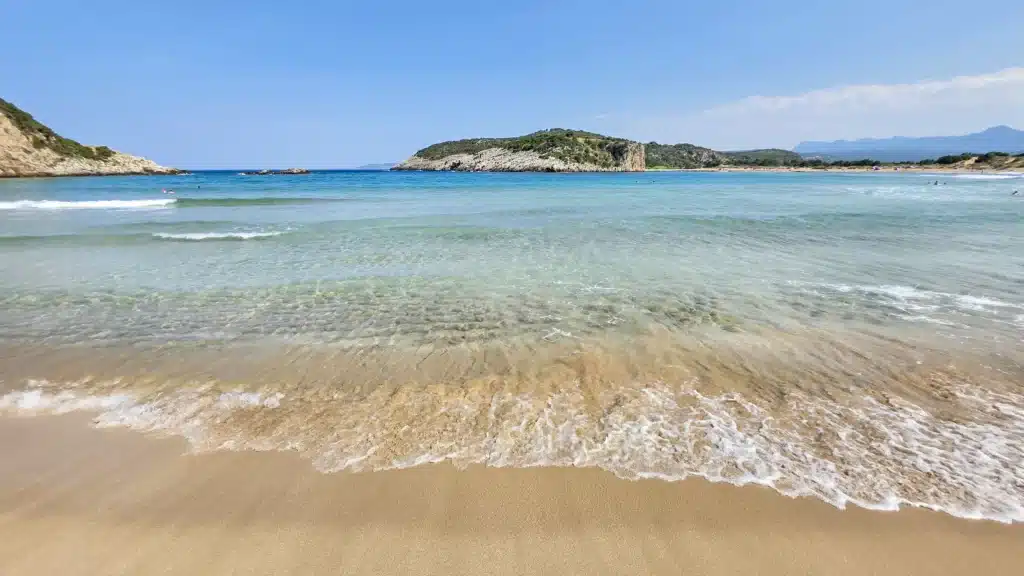
Christopher Nolan’s 2026 film The Odyssey was shot in several countries, and all of its officially confirmed Greek filming locations are in the Peloponnese. Most sit close together in Messenia, around the coastal towns of Pylos and Gialova. One, Acrocorinth, stands apart in the north-eastern Peloponnese, closer to Athens. This guide sets out where the locations are, what is actually confirmed about them, and how to visit them realistically on a short road trip.
Where was The Odyssey filmed in Greece?
The list of Greek locations comes from two official sources: the Hellenic Film Commission and EKKOMED – Creative Greece. They publish slightly different lists and spellings, but together they identify six confirmed sites — Voidokilia Beach, Nestor’s Cave, Almyrolaka (also written Armyrolakkos), Pylos and Methoni Castle in Messenia, plus Acrocorinth in Corinthia. Five of the officially listed locations are in Messenia, with the easiest-to-visit sites concentrated around Pylos and Gialova. Acrocorinth requires a separate day.
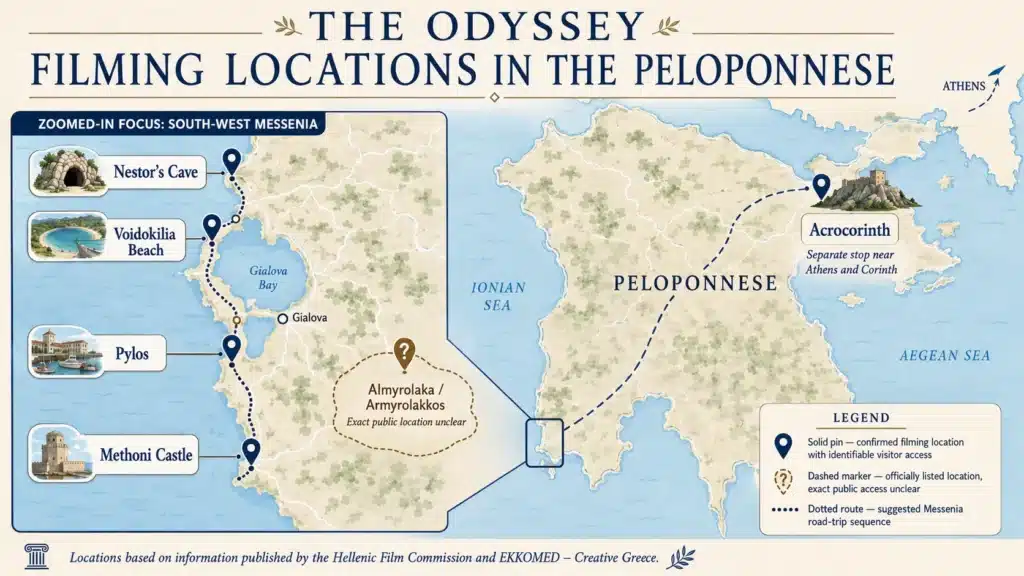
Quick trip facts
- Best base: Pylos or Gialova
- Recommended stay: two full days, usually two or three nights
- Transport: a rental car is effectively necessary
- Separate location: Acrocorinth, closer to Athens
- Hardest location to identify: Almyrolaka
- Confirmed Cyclops location: Nestor’s Cave
What is actually confirmed?
Two things are solid. The locations themselves are officially confirmed, and Nestor’s Cave is clearly linked to the Cyclops sequence. Beyond that, detailed scene-by-scene information for the other Greek locations remains limited, so this guide treats them as real places to visit rather than identified sets.
Voidokilia Beach
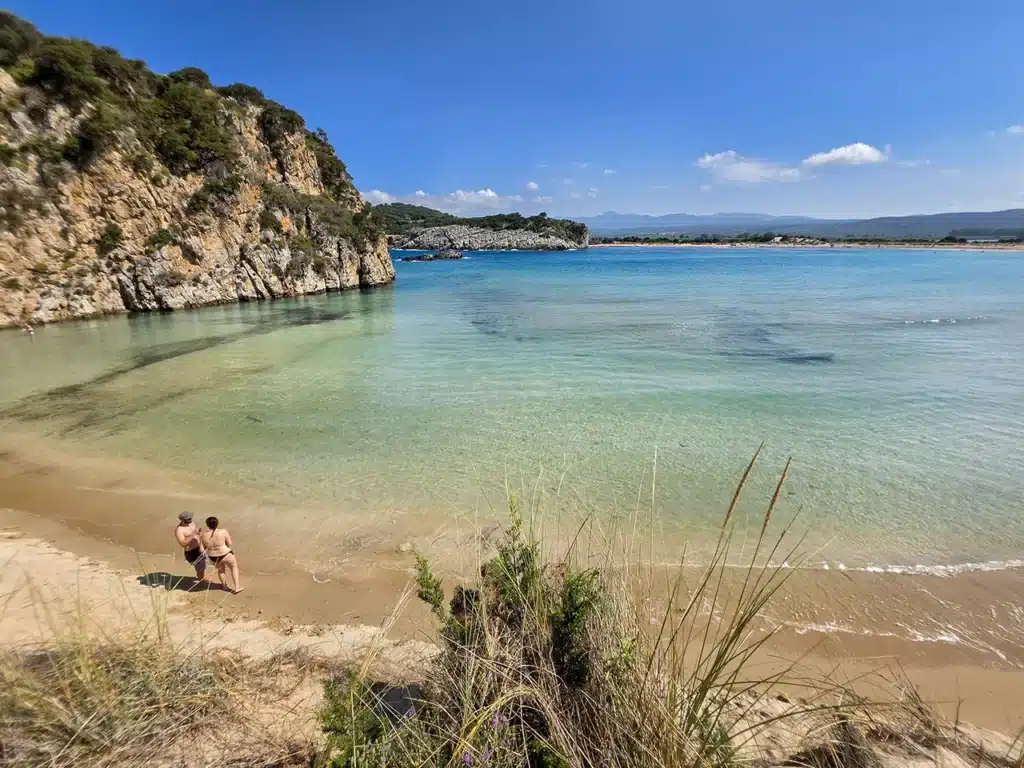
Voidokilia is one of the officially confirmed Greek filming locations, although the production has not publicly attributed a specific scene to it. It is also the most recognisable: a near-perfect horseshoe of sand near Gialova and Pylos.

Why visit
The setting is part of the appeal. The beach belongs to a sensitive coastal system linked to Gialova Lagoon and Navarino Bay, within a Natura 2000 area. It is a natural beach rather than an organised resort strip.
What to know before you go
⚠️ Facilities are minimal. Bring water, sun protection and suitable footwear if you walk beyond the sand, and take your rubbish away with you.
In high summer, early morning or late afternoon is more comfortable than midday. Keep to the beach and marked paths rather than the protected dunes.
Nestor's Cave
Nestor’s Cave sits above Voidokilia, on the slopes near Paleokastro. It is the one Greek location with a clear scene link: it was used for the Cyclops sequence.
What to know before you go
⚠️ The cave interior is not officially open to visitors. You can walk in the surrounding landscape and reach viewpoints over the bay, but this should not be treated as an authorised cave visit.
The approach is exposed and uneven, with little shade. In extreme summer heat the walk can be unsuitable, so choose a cooler part of the day and wear proper footwear.
Almyrolaka (Armyrolakkos)
Almyrolaka is an officially listed filming location, though the least straightforward to place on the ground. It also appears as Almyrolakkas or Armyrolakkos, depending on the source or map.
Public information about its exact position and access is limited. For that reason, it is best treated as a name on the official list rather than a fixed stop. Confirm access locally before setting out, and do not build an itinerary around reaching it.
Pylos
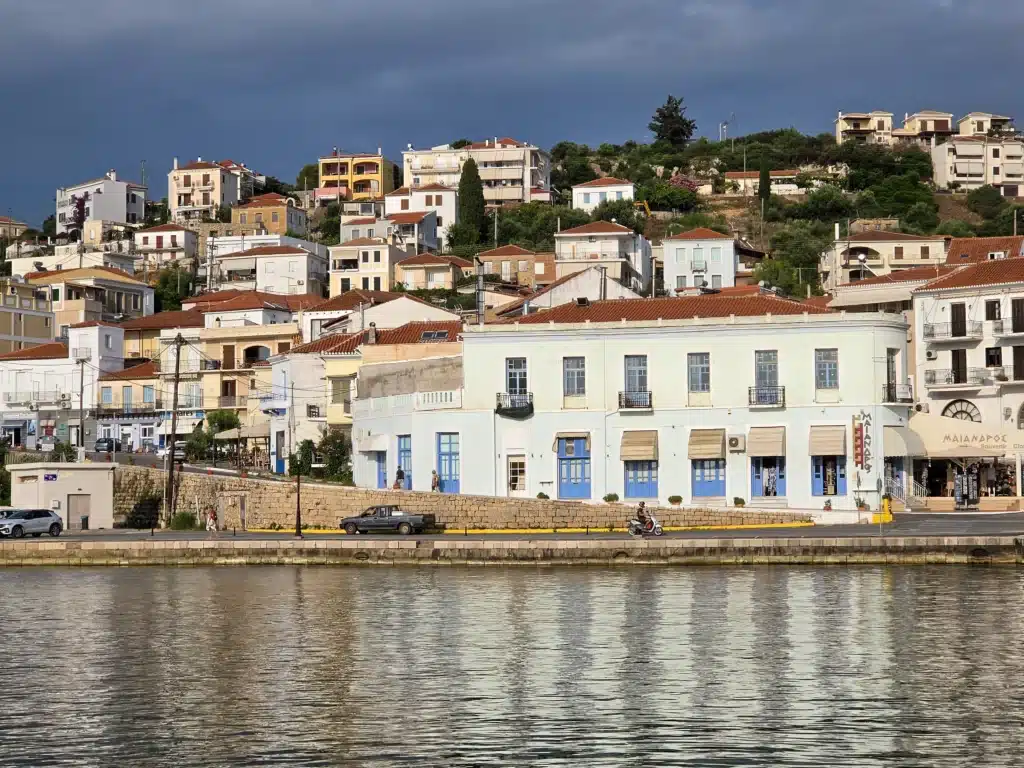
Pylos is both an official production location and the most practical base for this corner of Messenia. A working harbour, plenty of restaurants and an easy waterfront walk make it a comfortable place to return to each evening.
From here, Methoni, Gialova and Voidokilia are all short drives away. Evenings are relaxed, with tavernas around the square and along the seafront.
Methoni Castle
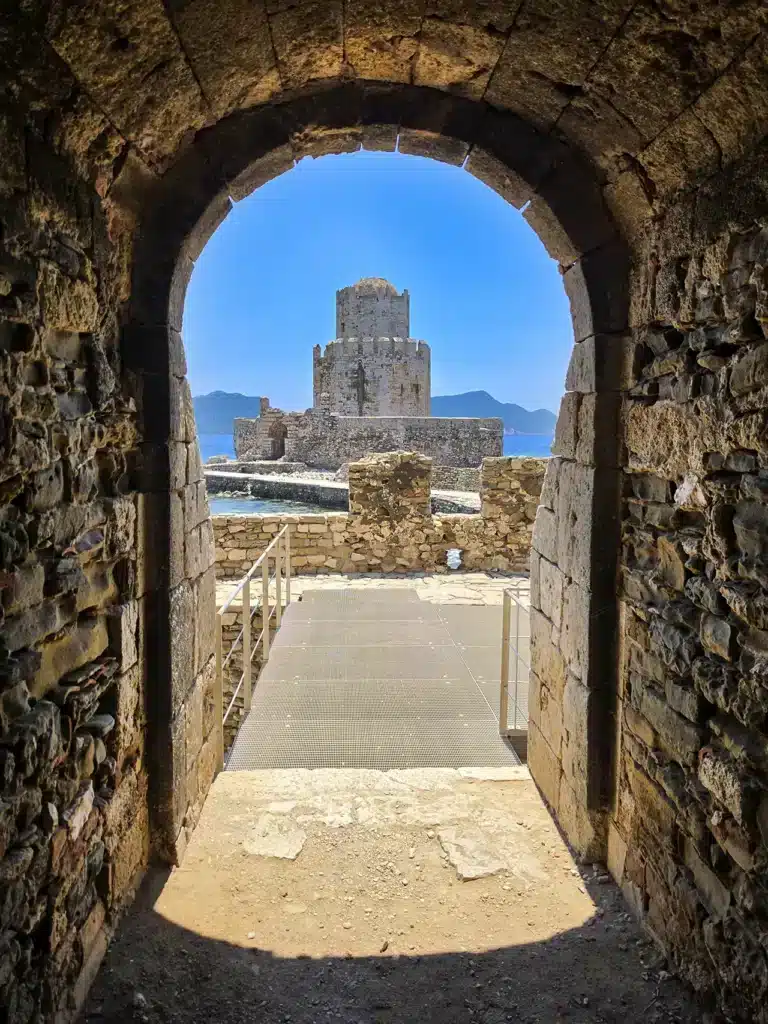
Methoni Castle is one of the largest fortified sites in the Peloponnese and an easy addition to any Pylos-based day.
Why visit
The fortified town flourished under Venetian rule between the 13th and 15th centuries. A long stone bridge of fourteen arches leads into the main enclosure, with sea-facing walls beyond and the Bourtzi tower on its own narrow causeway.
What to know before you go
⚠️ The site is large and largely unshaded, so bring water, a hat and proper footwear for uneven stone. Opening hours, closed days and admission fees change with the season; check the current details from the Greek Ministry of Culture before visiting.
Acrocorinth
Acrocorinth is a fortified acropolis on a rock roughly 575 metres high, above Ancient Corinth. It is the one Greek location that does not fit with the others.
Why it is a separate stop
Ancient Corinth lies about 3 kilometres below, and the fortress is around 90 kilometres from central Athens — normally a little over an hour by car. From Pylos it is almost 200 kilometres away, so it does not belong in a Messenia day.
What to know before you go
⚠️ The ground inside the walls is steep and uneven, with a long climb to the higher points. Wear proper shoes, carry water, and confirm opening times close to your visit.
How to visit The Odyssey filming locations in the Peloponnese
A rental car is effectively necessary for visiting these locations efficiently. Public transport does not link the route conveniently, and the beaches and castle are spread along small roads. Planning around a car also makes it easier to time visits for cooler parts of the day. For the wider route, including car rental and timing, see our guide to planning your Peloponnese road trip.
Getting there
There are two common approaches. Flying into Athens gives the widest choice of flights, but leaves a drive of roughly three and a half to four hours to Pylos, depending on your starting point and traffic.
A seasonal flight to Kalamata is the shorter option when schedules allow, putting you roughly an hour from Pylos. Either way, collect the hire car at the airport rather than relying on onward connections.
Best time of year
Late spring and early autumn are the easiest for this kind of trip: warm enough for the beaches, mild enough for the castle and the walk above Voidokilia. July and August are hot and busier, which is exactly when the exposed sites are least comfortable in the middle of the day.
Whenever you go, the open-air locations reward an early start or a late-afternoon visit over the midday hours.
Recommended two-day Messenia itinerary
Two days, or two nights, in the Pylos–Gialova area is the most comfortable plan.
Day one: Pylos, then Gialova and Voidokilia, with optional nearby viewpoints if the weather and light are suitable.
Day two: Methoni Castle and a walk through Methoni town, with an optional stop at the Palace of Nestor. The palace is a related archaeological site, not one of the officially confirmed filming locations.
Compressed one-day alternative
With only a day, start at Methoni Castle early, move on to Pylos, then Gialova, and finish at Voidokilia in the late afternoon. This is a full and relatively fast day.
Almyrolaka and Acrocorinth do not fit into it. Nestor’s Cave is best left as an optional walk for well-equipped visitors who have enough time and suitable weather.
How to include Acrocorinth
Acrocorinth works best on its own — from Athens, or near Corinth — at the beginning or end of a Peloponnese road trip. Allow time for both the fortress and Ancient Corinth below. Pair the visit with the Corinth Canal, then continue towards Nafplio for the next overnight stop — see the complete Nafplio travel guide.
Where to stay for The Odyssey filming locations
For the Messenia cluster, Pylos and Gialova are the two main choices.
Pylos offers the best overall balance of harbour, restaurants and short drives to the other sites. Gialova is strongest for proximity to Voidokilia and the lagoon, though it is smaller and quieter.
Methoni suits travellers who want the castle nearby and a slower stay. Kalamata — see our Kalamata travel guide — is useful mainly for airport access and city services, at the cost of a longer daily drive. Corinth or Loutraki is relevant only if you are visiting Acrocorinth.
The coastal villages are small, so it is worth booking earlier for July and August, when rooms fill quickly.
For most first-time visitors, Pylos is the safest all-round choice. Choose Gialova if beach access and proximity to Voidokilia matter more than having a larger town around you.
For the wider region, see our guide on where to stay in the Peloponnese.
Nearby places beyond the film
Homeric and archaeological extension
The Palace of Nestor adds historical and mythological context near Pylos. It is a Mycenaean site tied to the Homeric world, but it is not a confirmed film location.
Nearby natural landscape
Gialova Lagoon, the Paleokastro surroundings and Navarino Bay shape the scenery around Voidokilia. They are worth seeing in their own right, but they are not among the officially confirmed filming locations listed above.
Historical stops near Acrocorinth
Ancient Corinth and the Corinth Canal pair naturally with Acrocorinth. The canal is a modern engineering landmark rather than an ancient site.
Frequently asked questions
Where was The Odyssey filmed in Greece?
All confirmed Greek locations are in the Peloponnese. Five sit in Messenia — Voidokilia Beach, Nestor’s Cave, Almyrolaka, Pylos and Methoni Castle — around Pylos and Gialova. The sixth, Acrocorinth, is in Corinthia, closer to Athens, and is best treated as a separate stop.
What scene was filmed at Nestor's Cave?
Nestor’s Cave was used for the Cyclops sequence. It is the only Greek location with a clearly confirmed scene. Other sites were used in the production, but their specific scenes have not been publicly detailed.
Can tourists enter Nestor's Cave?
No. The cave interior is not officially open to visitors. You can walk in the surrounding landscape and reach viewpoints over the bay, but the inside should not be treated as an authorised attraction. The approach is exposed, so avoid the midday heat.
How many days do you need for the Greek filming locations?
Two days in the Pylos–Gialova area is the comfortable choice for the Messenia locations. A single fast day is possible if time is tight. Acrocorinth is almost 200 kilometres away and needs its own outing, usually from Athens or Corinth.
Where should you stay for the Messenia locations?
Pylos is the most balanced base, with a harbour, restaurants and short drives to the other sites. Gialova is best for proximity to Voidokilia but quieter. Methoni suits castle-focused stays, and Kalamata is mainly useful for its airport.
Making the most of the trip
Most visitors need one or two days in Messenia, based in Pylos or Gialova, to see the confirmed locations at a comfortable pace. Acrocorinth is better treated as its own stop, near Athens or Corinth. Even setting the film aside, a horseshoe beach, sweeping coastal viewpoints and a vast Venetian castle make the drive worthwhile. If you are still deciding where else to go, our guide to the best Peloponnese resorts and destinations compares the regions.


