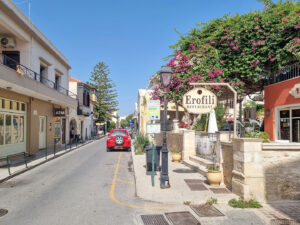
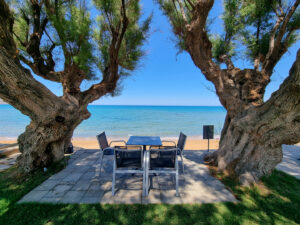
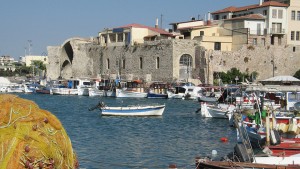
Crete in one minute: Greece’s largest island divides into four very different travel regions — Chania, Rethymno, Heraklion and Lasithi. Choosing the right region and airport matters more than choosing the hotel. This guide walks you through that decision first, then covers beaches, sights, car hire and family planning.
The single most important decision when planning a holiday in Crete is not which hotel to book — it is which part of the island to stay in. Crete stretches a long way from west to east, and a beautiful hotel in the wrong region can leave you hours away from the beaches and sights you actually came for.
In practice, the island divides into four main travel regions. Chania, in the west, has the famous beaches — Balos, Elafonissi, Falassarna — plus a Venetian old town and access to the Samaria Gorge. Rethymno, in the centre-west, offers an attractive old town and a very balanced base for exploring in both directions. Heraklion is the archaeology and logistics hub: Knossos, the Archaeological Museum, one of the island’s main airports and the island’s biggest resort areas. Lasithi, in the east, means Agios Nikolaos, Elounda, Spinalonga and a generally quieter style of holiday.
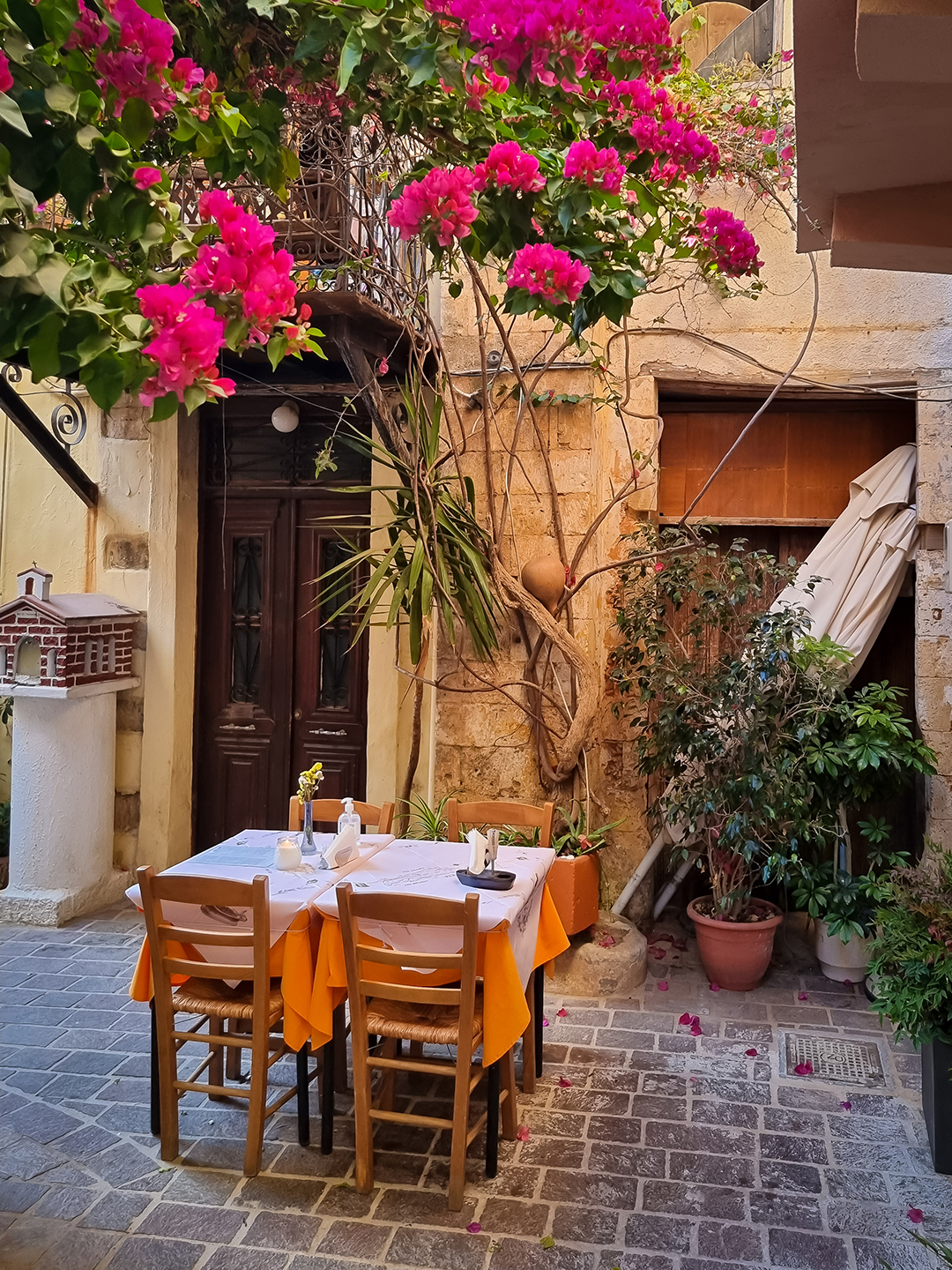
None of the four is universally “best”. The right choice depends on what kind of trip you want — and the sensible planning order is: region first, then base or resort, then accommodation, then day trips. For a typical one-week holiday, pick one main part of Crete and explore it properly rather than crossing the island every other day.
Which part of Crete should you choose?
| If you want… | Consider… |
|---|---|
| First trip to Crete | Chania or Rethymno |
| The famous western beaches (Balos, Elafonissi, Falassarna) | Chania region |
| An atmospheric old town | Chania or Rethymno |
| Knossos and archaeology | Heraklion |
| A balanced base with access in both directions | Rethymno |
| Large resorts and easy facilities | Heraklion region / Hersonissos area |
| Agios Nikolaos, Elounda and Spinalonga | Lasithi |
| Quieter eastern Crete | Lasithi |
| A family holiday | Depends on the resort and beach — see the family section below |
| A road trip | Two bases (west + centre, or centre + east) rather than crossing the island daily |
Already have an idea? See accommodation in Crete on Booking.com and compare the areas on the map as you read.
Contents:
Crete at a glance
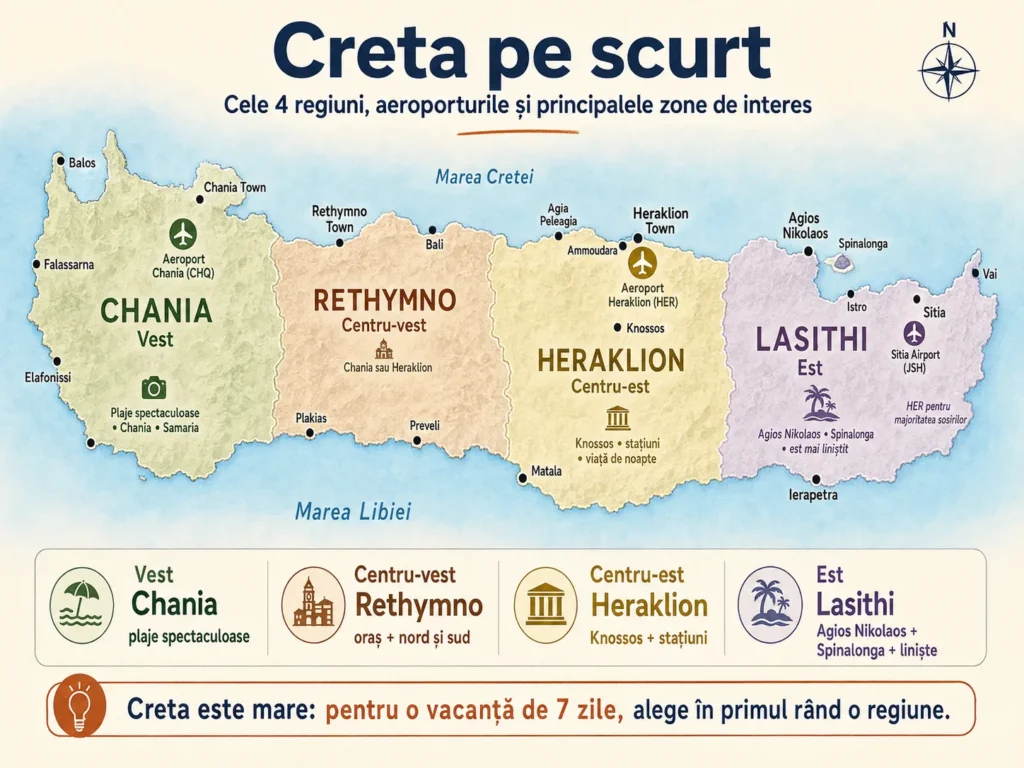
Before the details, the essentials:
- Size: Greece’s largest island, stretching a long way from west to east. Real driving distances are significant, and journey times matter more than kilometres.
- Airports: two main international gateways — Chania (CHQ) in the west and Heraklion (HER) in the centre — plus the much smaller Sitia Airport (JSH) serving eastern Crete with far fewer connections.
- Roads: most major roads and tourist infrastructure run along the north coast. Reaching some south-coast destinations takes noticeably longer than the map suggests.
- How long: a week works well for one region; four to five days suit a single base with a couple of nearby trips.
- Regions: Chania, Rethymno, Heraklion and Lasithi — each with a distinctly different character.
| Region | Usual airport | Famous beaches | Best known for |
|---|---|---|---|
| Chania (west) | Chania (CHQ) | Balos, Elafonissi, Falassarna | Venetian old town, spectacular beaches, Samaria Gorge |
| Rethymno (centre-west) | Chania or Heraklion | Preveli, Plakias, Bali | Well-preserved old town, balanced central base |
| Heraklion (centre-east) | Heraklion (HER) | Matala, Ammoudara, Agia Pelagia | Knossos, Archaeological Museum, big resort areas |
| Lasithi (east) | Heraklion; Sitia (JSH) for the far east | Vai, Voulisma / Istro | Agios Nikolaos, Elounda, Spinalonga, quieter itineraries |
Chania: western Crete and the famous beaches

Best for: the beaches that made Crete famous, an atmospheric historic city, gorge hiking, western road trips.
The atmosphere: Chania Town has one of the most photogenic Venetian harbours in Greece, with a lived-in old town of narrow lanes, restaurants and small hotels. West of the city, the coastline runs through beach resorts such as Agia Marina and Platanias before reaching the wilder far west around Kissamos.
Main bases: Chania Town and Nea Chora for the city; Agia Marina and Platanias for classic beach holidays; Kissamos for Balos and the far west. Beaches and sights: Balos lagoon, Elafonissi with its pink-tinged sand, the long sandy sweep of Falassarna, and the Samaria Gorge — the best-known hiking trail in Crete.
Who should stay here: travellers who put beaches and scenery first, first-time visitors, and anyone drawn to a historic city base. Possible downside: the famous beaches are one to two hours’ drive from the city and get very busy in July and August — and Chania is inconvenient if Knossos, Agios Nikolaos or eastern Crete are your main priorities.
Rethymno: the balanced base
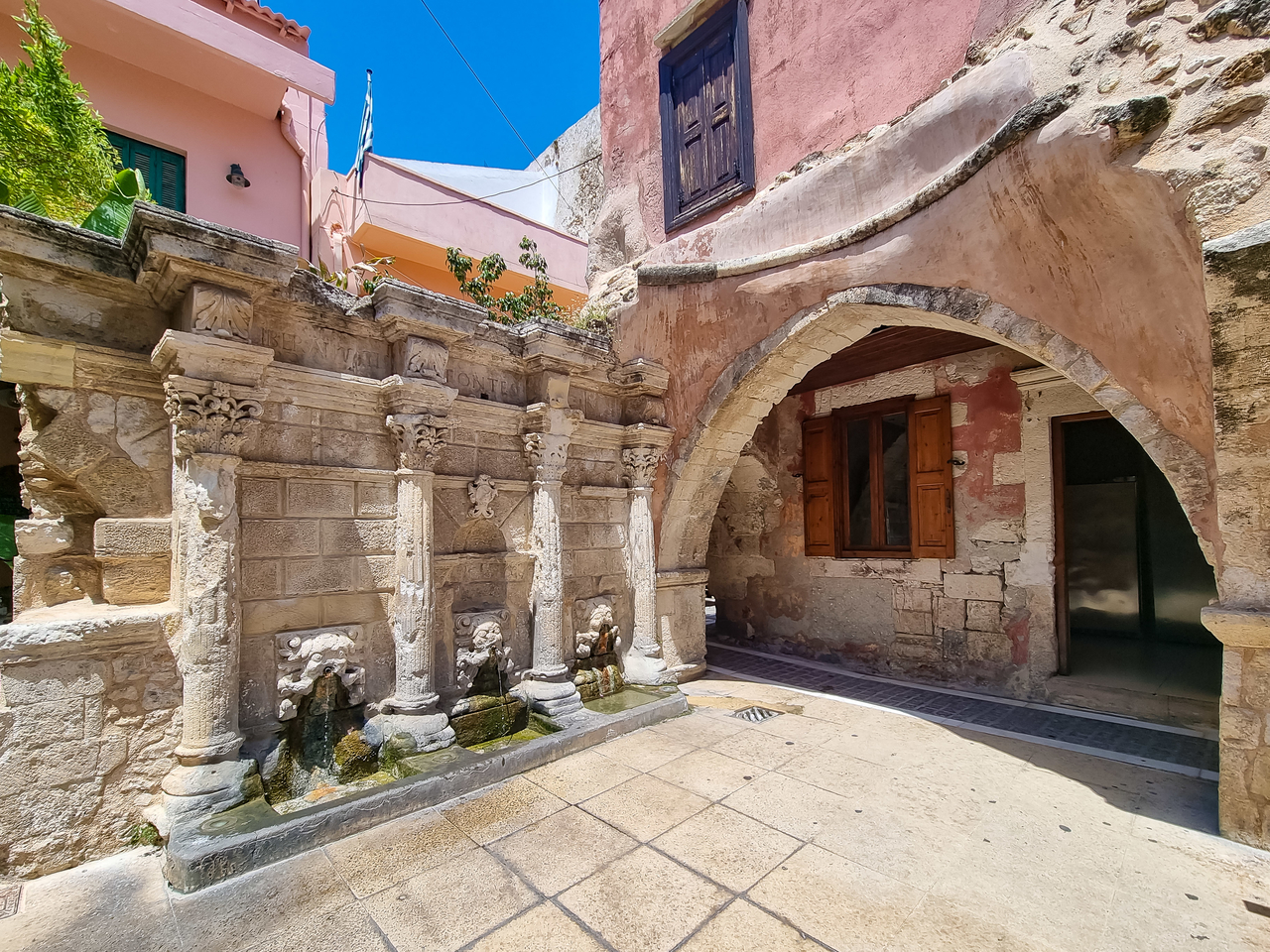
Best for: a balanced first-trip base, old-town atmosphere, reaching both the north and south coasts.
The atmosphere: Rethymno has one of Crete’s best-preserved old towns — a compact maze of Venetian and Ottoman-era streets below a large fortress — plus a long town beach that starts right at the edge of the centre. It is smaller and quieter than Chania or Heraklion, without feeling remote.
Main bases: Rethymno Town, the hotel strip east of it, Bali and Panormo on the north coast, Plakias and Agia Galini on the south coast. Beaches and sights: the palm-backed beach at Preveli, the Plakias area, Arkadi Monastery and the mountain villages inland.
Who should stay here: couples, travellers who want one base with day trips in both directions, and anyone who prefers an old town over a big resort. Possible downside: Rethymno has no major airport of its own — you fly into Chania or Heraklion and transfer along the north coast.
Heraklion: Knossos, museums and big resorts

Best for: archaeology, airport convenience, established resort infrastructure, families who want everything within reach.
The atmosphere: Heraklion city is the island’s capital — busier and more urban than Chania or Rethymno, and less conventionally picturesque, but much stronger for archaeology and logistics. The Palace of Knossos sits just outside the city, and the Heraklion Archaeological Museum holds one of the world’s most important collections of Minoan artefacts. East of the airport, the coast runs through resort country: Gouves, Hersonissos, Stalida and Malia.
Main bases: Heraklion city for a short cultural stay; Ammoudara and Agia Pelagia west of the city; Gouves, Hersonissos and Malia to the east for resorts, water parks and nightlife. Beaches and sights: Knossos, the Archaeological Museum, Matala with its famous caves on the south coast, and the long resort beaches of the north.
Who should stay here: families who want large resorts and easy facilities, culture-focused travellers, and anyone prioritising a short airport transfer. Possible downside: the north coast here is heavily developed, and the city itself suits a night or two better than a full beach week.
Lasithi: Agios Nikolaos, Elounda and the quieter east

Best for: the Mirabello Gulf, Spinalonga, upmarket resorts around Elounda, quieter eastern itineraries.
The atmosphere: eastern Crete moves at a different pace. Agios Nikolaos is a genuine coastal town built around a small lake and harbour; Elounda and Plaka to its north are the island’s best-known upmarket resort area, facing the island fortress of Spinalonga. Further out lie Sitia, the palm beach at Vai, and Ierapetra on the warm south coast.
Main bases: Agios Nikolaos for town plus beaches, Elounda and Plaka for resort stays, Ierapetra for the south, Sitia for the far east. Beaches and sights: Spinalonga, the sandy bays at Voulisma / Istro, Vai’s palm grove, and the Lasithi Plateau inland.
Who should stay here: couples, return visitors, and travellers who prefer a quieter, more eastern-focused itinerary. Possible downside: it is far from Balos, Falassarna, Elafonissi and most western-Crete highlights — do not plan those as day trips from here.

Where to stay in Crete
Choose in this order: region → base → property. Booking a lovely hotel first and only then discovering that everything you want to see is hours away is the most common planning mistake on this island.
The main bases, region by region: in the west, Chania Town, Nea Chora, Agia Marina, Platanias and Kissamos; in the centre-west, Rethymno Town, Bali and — on the south coast — Plakias; in the centre, Heraklion city, Ammoudara, Agia Pelagia, Gouves, Hersonissos and Malia; in the east, Agios Nikolaos, Elounda, Ierapetra and Sitia. Most of the large resort areas are concentrated along the north coast, connected by the island’s main road — practical for day trips, but more built-up. The south is quieter, with slower access roads.
Compare availability by region on Booking.com: Chania · Rethymno · Heraklion · Agios Nikolaos.
The best beaches in Crete — by region
Crete’s famous beaches are spread across a very large island, so where you stay determines which of them are realistic day trips. Think of them geographically rather than as one list.
Western Crete (Chania region): Balos lagoon — reached by an unpaved road and a walk down, or by boat from Kissamos; Elafonissi — pink-tinged sand and shallow water, wonderful early in the day and very busy at peak hours; Falassarna — a long, organised sandy beach known for its sunsets.
Central and southern Crete: Preveli, below a river gorge lined with natural palms (steep steps or boat access); the relaxed Plakias area; and Matala, with its famous caves and 1960s history.
Eastern Crete (Lasithi): the sandy bays around Voulisma and Istro on the Mirabello Gulf; Vai, home to one of Europe’s most significant natural palm groves, at the island’s far eastern tip; and selected Mirabello Gulf beaches near Agios Nikolaos.
Two honest caveats: some of the most spectacular beaches demand some effort — unpaved roads, walks, or early starts — and sea conditions change with the wind, so no beach guarantees calm water on any given day. If you are staying in eastern Crete, do not plan Balos and Elafonissi as casual day trips; they belong to a western itinerary.
Things to do in Crete
Towns: Chania’s Venetian harbour and old quarter; Rethymno’s fortress and medieval lanes; Heraklion for its museums; Agios Nikolaos with its lake at the centre of town.
Minoan Crete: the Palace of Knossos, just outside Heraklion, is the island’s flagship site — best combined with the Heraklion Archaeological Museum, where the original frescoes and finest Minoan artefacts are displayed. Other major archaeological sites include Phaistos, another important Minoan centre, and Gortyna, known mainly for its later Greek and Roman history. In 2025, the Minoan Palatial Centres were inscribed on the UNESCO World Heritage List — a serial property covering Knossos, Phaistos, Malia, Zakros, Zominthos and Kydonia (in Chania).
Gorges and nature: the Samaria Gorge is Crete’s best-known hike — roughly 16 km, descending five to seven hours to the coast at Agia Roumeli, with a ferry connection onward. The season normally runs from May to October, but daily opening depends on weather and trail conditions, so check the official information before setting out. Shorter alternatives include the Imbros and Kourtaliotiko gorges.
Islands and the south: the fortress island of Spinalonga, visited by boat from Plaka or Elounda; Loutro, reachable only on foot or by boat; and the slow, scenic villages of the south coast.
How many days do you need in Crete?
- 3–4 days: focus on one city or region plus nearby highlights — Chania and a couple of western beaches, or Heraklion with Knossos and the museum.
- 7 days: the classic format. One primary region explored properly, with two or three realistic day trips and proper beach time.
- 10–14 days: much better for combining two regions or two accommodation bases — for example Chania + Rethymno, or Heraklion + Agios Nikolaos, with one mid-stay move.
On timing: June and September usually offer the best balance of weather, crowds and prices. July and August are hot, with heatwaves sometimes pushing daytime temperatures above 35°C, while beaches are busiest and accommodation prices are generally at their highest. May and October can be less busy and often cheaper, although conditions are more variable at the edges of the season — the sea can still be cool in early May, and some seasonal services in remote spots wind down later in October.
Do you need a car in Crete?
For most holidays, a car is very useful. The famous beaches, gorges, mountain villages and the south coast are scattered across the island, and car hire is what makes them all reachable on your own schedule. KTEL buses connect the main towns and some popular resorts and sights, but combining remote beaches, villages and the south coast in one trip is hard without your own wheels.
You can manage without a car if you stay in Chania, Rethymno or central Agios Nikolaos, use nearby beaches, and book organised excursions for the further-flung highlights — or if you settle into a full-service resort. For Balos, Elafonissi, Preveli and the south coast, no car means depending on buses and fixed-schedule tours.
Worth knowing before you drive here: away from the main north-coast road, roads are narrow and winding, so judge journeys in hours rather than kilometres; many hire contracts exclude unpaved roads — check the terms before driving towards Balos; parking in the old centres of Chania and Rethymno is difficult in summer, so use the car parks at the edge of the pedestrian zones. In July and August, booking car hire earlier generally gives you more choice, especially in the smaller vehicle categories.
Crete with children
Crete works well for families under two conditions: choose a base close to a beach with easy, shallow water, and do not pack too many long drives into the week. Prioritise a manageable airport transfer, a practical location for food and facilities, and shorter day trips — the base matters far more than the brochure.
For days off the beach, the island has several big family attractions: Limnoupolis Water Park near Chania, Watercity and Acqua Plus in the Heraklion / Hersonissos area, and CretAquarium near Heraklion — an aquarium rather than a water park, and a good option on windy days. Not every famous beach suits young children: Elafonissi’s shallow water is excellent early in the day but the beach gets crowded and windy later, and Balos involves a rough road and a walk.
Chania Airport or Heraklion Airport?
The rule: choose the airport based on where you are staying, not the other way around. Chania and Heraklion are roughly a two-hour-plus drive apart along the north-coast road, depending on traffic, road conditions and your exact start and end points — a transfer you do not want to add to both ends of your holiday.
- Chania (CHQ): usually the right choice for western Crete — Chania, the western beaches, and often Rethymno.
- Heraklion (HER): usually the right choice for central and eastern Crete — Knossos, Hersonissos, Agios Nikolaos and beyond.
- Rethymno: sits between the two airports, so either can work depending on flight availability and your exact accommodation.
- Sitia (JSH): a much smaller airport that can suit far-eastern itineraries, but with limited connections — check current routes before relying on it.
Ferries also link Piraeus (Athens) with Heraklion and Chania (Souda port) — usually overnight crossings of roughly nine to ten hours, with the option of taking a car aboard. Worth considering if you are combining Crete with Athens.
Where should you stay on your first trip to Crete?
There is no universal winner — but there is a right answer for your trip. Use this logic:
Choose Chania if: the western beaches are a priority, you want an atmospheric historic city, Balos / Falassarna / Elafonissi are on your list, and western Crete is your main focus.
Choose Rethymno if: you want a balanced base, you like old-town atmosphere, you want access towards both the north and south coasts, and being next to an airport is not essential.
Choose the Heraklion region if: Knossos and archaeology matter, airport convenience is important, you want established resort infrastructure, and a central position is useful.
Choose Lasithi if: Agios Nikolaos is a priority, you want Elounda, Plaka and Spinalonga, eastern Crete appeals to you, and you prefer a quieter, more eastern-focused itinerary.
Common mistakes to avoid
- Trying to see the whole island in a week. The result is four to five hours of driving a day and no relaxation. Choose one half of Crete.
- Choosing the wrong airport. Flying into Heraklion with accommodation near Chania adds a long cross-island transfer at both ends of the trip.
- Judging distances in kilometres rather than hours. In the mountains and towards the south coast, real average speeds are often low.
- Booking car hire late. In peak season, booking earlier generally gives you more choice, particularly in the smaller vehicle categories.
- Overloading the schedule with children. One longer excursion every couple of days is plenty; the rest is beach and pool.
- Choosing a beach from photos alone. Balos looks flawless in pictures, but it demands an unpaved road, a walk and patience with crowds. Check the access first.
- Staying far from what you want to see. A cheap but isolated resort costs you time and fuel every single day.
Where to start
The practical steps, in order: choose your region — west for Chania and the famous beaches, the centre for Rethymno or for Knossos and the big resorts, east for Agios Nikolaos, Elounda and quieter Lasithi. Then choose the matching airport, your base, your accommodation and your car. Everything else — beaches, gorges, archaeological sites — falls into place around those decisions.
Search accommodation directly in your chosen region. Many properties offer free cancellation; always check the exact conditions for your room and dates.
Stays in Chania (west) Stays in Rethymno (centre) Stays in Heraklion (centre-east) Stays in Agios Nikolaos (east)